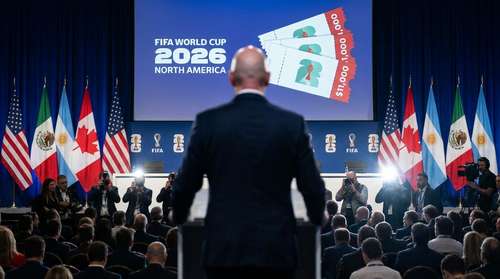
The feverish anticipation surrounding the upcoming tournament in the United States, Canada, and Mexico is quickly transforming into profound frustration. As the summer kickoff rapidly approaches, the conversation has violently shifted from the pitch to the pocketbook. At the center of the growing 2026 World Cup ticket prices storm is FIFA President Gianni Infantino. Speaking at the prestigious Milken Institute Global Conference in Beverly Hills on Tuesday, the executive boldly doubled down on a highly criticized pricing structure that lists prime face-value seats for the championship match at a staggering $11,000.
This drastic inflation has triggered intense backlash across the globe, escalating a fierce FIFA World Cup controversy. For context, the equivalent top-tier ticket for the 2022 final in Qatar cost roughly $1,600 at face value. The dramatic spike represents nearly a 600 percent increase, transforming what is historically billed as the people's game into an exclusive luxury experience. For millions of working-class supporters, attending the globe's biggest sporting spectacle has shifted from a lifelong dream to an absolute financial impossibility.
A "Monumental Betrayal" and Mounting Legal Action
Outrage over this aggressive commercial pivot has moved well beyond social media grievances and organized boycotts. Football Supporters Europe (FSE), a prominent international fan advocacy organization, has publicly condemned the governing body. Representatives described the cost structure as "extortionate" and officially branded the entire operation a "monumental betrayal" to the sport's grassroots foundations. The sheer scale of the World Cup 2026 ticket outrage is unmatched in recent tournament history.
This rhetoric is now backed by unprecedented legal maneuvering. In March, FSE officially escalated the dispute by filing a FIFA ticket price lawsuit directly with the European Commission. The litigation targets the organization over alleged "excessive ticket prices," arguing that the governing body is exploiting its monopoly over the event to squeeze unprecedented revenue from loyal fans.
Adding insult to injury, the latest round of last-minute ticket drops in April was marred by chaotic technical glitches. Frustrated buyers expecting a smooth transaction were misdirected to secure portals meant for official national team groups, resulting in massive wait times and locked screens while prices arbitrarily surged.
Infantino's "Market Rates" and the Resale Windfall
Despite the palpable anger, the Gianni Infantino World Cup 2026 strategy remains fiercely unapologetic. During his Beverly Hills appearance, he justified the extraordinary inflation by pointing directly to the unique economic landscape of the host nations.
"We have to look at the market—we are in the market in which entertainment is the most developed in the world. So we have to apply market rates," the president explained to the crowd of global investors and executives. He argued that deliberately underpricing tickets would simply create a massive windfall for scalpers, given that the United States broadly permits secondary market resales for thousands of dollars above face value.
The Absurd Secondary Market and FIFA's Hidden Cut
The secondary market is already spiraling into the realm of the absurd, driving the World Cup final ticket cost into the stratosphere. Recently, FIFA's own official resale website featured four tickets for the July 19 final at MetLife Stadium in New Jersey listed at a mind-bending $2.3 million each.
While Infantino brushed off these astronomical figures by noting that asking prices rarely reflect actual sales, he couldn't resist a quip about the sheer absurdity of the listings. "If somebody buys a ticket for the final for $2 million, I will personally bring him a hot dog and a Coke to make sure that he has a great experience," he joked.
Yet, critics argue that the governing body itself benefits from this unregulated secondary market. FIFA extracts a 15 percent purchase fee from the buyer and a 15 percent resale fee from the seller on its official platform. If a secondary ticket did somehow move for $2.3 million, the organization would theoretically pocket a staggering $690,000 in fees from a single transaction.
Unprecedented Demand and the 2026 World Cup North America
Behind closed doors, officials are looking at raw data that severely undercuts the public outcry. Infantino revealed that administrators have fielded over 500 million ticket requests for the expanded 104-match tournament. To put that staggering figure in perspective, it represents ten times the 50 million combined requests received for the 2018 and 2022 tournaments.
While acknowledging the soaring top-end prices, the executive stressed that accessible options still exist for the 2026 World Cup North America. Approximately 25 percent of the group-stage inventory is purportedly priced under $300. "You cannot go to watch in the US a college game, not even speaking about a top professional game of a certain level, for less than $300," he noted. "And this is the World Cup".
As the opening ceremonies loom, the tension between undeniable commercial realities and traditional fan expectations has reached a boiling point. Organizers are clearly banking on the immense wealth and ingrained sports-spending habits of the American market to guarantee packed stadiums and record-breaking revenues. While wealthy attendees and elite corporate sponsors will undoubtedly fill the luxury suites at MetLife Stadium this July, the ongoing legal battles and furious global protests suggest a lasting cultural rift. For many traditional supporters, the soul of the beautiful game has finally been priced out of reach.