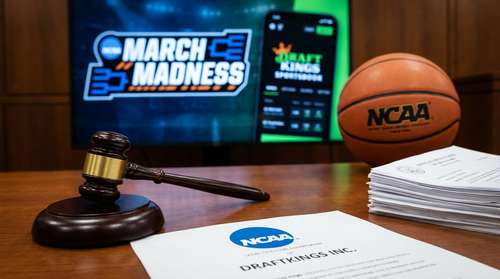
Just as the opening weekend of the men's and women's college basketball tournaments reached a fever pitch, the governing body of collegiate athletics lobbed a legal grenade at one of the world's largest sportsbooks. The NCAA vs DraftKings lawsuit, officially filed late Friday in federal court, accuses the betting giant of blatantly exploiting protected tournament terminology to fuel its seasonal wagering promotions.
The Core of the Sportsbook Trademark Infringement Claims
In a detailed 37-page complaint submitted to the U.S. District Court for the Southern District of Indiana, the NCAA is seeking an emergency DraftKings restraining order. The legal filing alleges that the sportsbook unlawfully used federally registered March Madness betting trademarks—including "Final Four," "Elite Eight," and "Sweet Sixteen"—across its mobile application, promotional graphics, and betting menus.
According to the lawsuit, DraftKings ignored initial requests to thoroughly scrub the protected terms, instead choosing to heavily embed them during a critical window of consumer engagement. The NCAA argues this calculated strategy was designed to "usurp the immense goodwill" of the organization exactly when public attention was peaking. Screenshots submitted as exhibits reportedly show the operator integrating these phrases directly into its user-facing wagering platforms, deliberately capitalizing on the tournament's massive audience.
Seeking a Swift Legal Blockade
Because the tournaments are advancing rapidly, the NCAA has requested the court implement the restraining order before the men's and women's third-round matchups commence next Thursday and Friday. Beyond an immediate halt to the marketing campaigns, the association is pursuing aggressive financial restitution. The governing body is demanding that DraftKings cover its attorneys' fees, and is seeking either triple the damages incurred by the NCAA or three times the profits DraftKings generated from the alleged sportsbook trademark infringement.
Protecting NCAA Tournament Branding Amidst Record Wagering
This aggressive litigation arrives against the backdrop of massive financial stakes. The American Gaming Association recently projected that Americans would wager upwards of $3 billion through legal channels on this year's brackets. With early Round of 32 betting trends showing unprecedented engagement, sportsbooks are fiercely competing for market share and new customer acquisitions.
However, the NCAA insists that this specific operator crossed the line by employing NCAA tournament branding to falsely signal an official partnership. The complaint notes that DraftKings also utilized "confusingly similar variations" of protected intellectual property, citing a specific "March Mania" survivor contest as a prime example. For an organization that fiercely polices its commercial rights, these unauthorized marketing tactics represent a direct threat to the exclusive broadcast and sponsorship deals that fund collegiate athletics.
A Deeper Mission: Shielding Athletes from Betting Harassment
The timing and severity of the NCAA's legal action go far beyond simple corporate copyright enforcement. The organization explicitly cited the protection of student-athletes and the preservation of competitive integrity as primary motivators for the lawsuit. In recent months, NCAA President Charlie Baker has aggressively lobbied state legislatures to ban collegiate proposition bets, citing a dramatic rise in online harassment directed at amateur athletes by disgruntled gamblers.
College basketball has already faced severe gambling headwinds recently. The sport dealt with a high-profile investigation involving Temple University in 2024, and just this past January, 20 college basketball players were indicted in a federal point-shaving case. The NCAA fears that implicitly endorsing sportsbooks could worsen these integrity issues.
The legal filing emphasizes that DraftKings' unauthorized use of tournament trademarks undermines these precise integrity efforts. By creating a false association between the championship events and a gambling platform, the NCAA argues that millions of vulnerable fans—particularly college students and young adults—are being misled. The association reiterated on Friday that it maintains zero commercial relationships with any sportsbooks and upholds a strict prohibition on betting sponsorships.
The Biggest Sports Betting Legal News of 2026?
As the legal showdown unfolds in Indianapolis, industry analysts are watching closely. This represents the first formal legal action the NCAA has taken directly against a major sportsbook over event terminology. If the federal judge grants the emergency injunction ahead of the Sweet 16, it could establish a massive precedent reshaping how oddsmakers market college sports moving forward.
DraftKings has not yet issued a detailed public response to the allegations. But as the tournament bracket narrows and the remaining teams prepare for the second weekend of competition, the fiercest battle may actually be taking place in a federal courtroom, making this the defining piece of sports betting legal news 2026 has seen thus far.