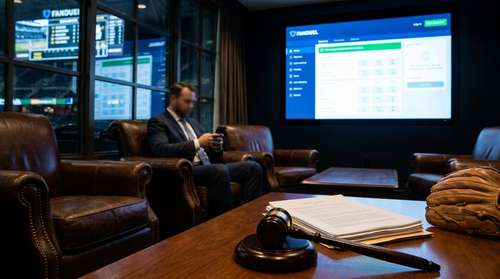
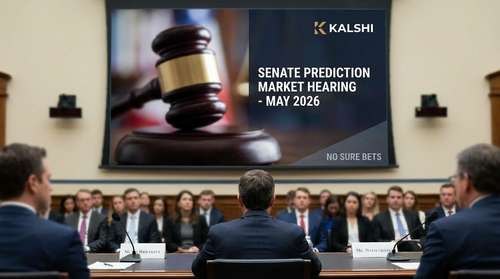
As the gavel falls in Russell Senate Office Building Room 253 this morning, the regulatory landscape of American gaming is entirely on the line. The historic Senate prediction market hearing convenes today, May 20, 2026, marking a pivotal crossroads for the future of sports-event contracts. Titled "No Sure Bets: Protecting Sports Integrity in America," the Senate Commerce Subcommittee session is forcing lawmakers to confront a multi-billion dollar question that can no longer be ignored. Congress is weighing competing legislative paths that will either formally integrate prediction platforms into the licensed sportsbook ecosystem or enact sweeping federal bans on sports-event contracts altogether.
Inside the "No Sure Bets" Hearing News
The hearing, chaired by Senator Marsha Blackburn (R-Tenn.), brings a deeply divided panel of witnesses to Capitol Hill. You can feel the tension in the room as industry heavyweights prepare to outline vastly different visions for US sports betting laws 2026. The critical witness panel includes:
- Hon. Patrick McHenry: Former Congressman acting as a senior advisor for the Coalition for Prediction Markets.
- Bill Miller: President and CEO of the American Gaming Association (AGA).
- Mary Beth Thomas: Executive Director of the Tennessee Sports Wagering Council.
- Dr. Harry Levant: Director of Gambling Policy at Northeastern Law’s Public Health Advocacy Institute.
- Scott Sadin: Co-Founder and CEO of Integrity Compliance 360.
McHenry’s core argument suggests that event contracts provide essential market data and hedging opportunities that deserve federal protection, not prohibition. Taking the opposite stance, Miller is emphasizing that unlicensed or loosely categorized event contracts pose a severe threat to consumer safety and state tax revenues. Furthermore, Dr. Levant is delivering critical testimony regarding the immediate public health impacts and addiction risks associated with the rapid proliferation of digital betting avenues.
The Escalating State vs. Federal Conflict
The regulatory clash isn't just theoretical; it is actively playing out in federal courts across the country. Tennessee regulators recently brought a high-profile case to the Sixth Circuit Court of Appeals against Kalshi, attempting to block the platform's sports-event contracts under local gambling restrictions. The state's opening brief, filed just two days ago on May 18, underscores the growing desperation of state gaming commissions trying to maintain territorial control over traditional sports betting regulation 2026.
Meanwhile, the conflict reached an unprecedented boiling point this week in the Midwest. Minnesota Governor Tim Walz signed the nation’s first comprehensive law banning prediction market sites from operating within state lines. Set to take effect in August, the law makes hosting or advertising such platforms a felony. In swift response, CFTC Chairman Michael Selig announced a lawsuit against the state, arguing that prediction markets fall under exclusive federal jurisdiction.
The Core Debate: Prediction Market vs Sportsbook
To understand the complex legislative gridlock in Washington, you must look at the fundamental mechanics underlying the prediction market vs sportsbook models. Unlike a traditional sportsbook where a bettor wagers directly against the house—which sets the odds and manages its own risk—prediction exchanges act purely as facilitators. They operate as financial derivatives markets where users trade shares based on the probability of a specific outcome. Because the market sets the price entirely through supply and demand, operators take a transaction fee rather than profiting directly from a user’s loss.
This foundational difference has allowed the Kalshi Polymarket sports betting ecosystem to expand rapidly outside traditional state-by-state licensing frameworks. Kalshi has held federal oversight as a Commodity Futures Trading Commission (CFTC) Designated Contract Market since 2020. Conversely, Polymarket historically operated offshore before spending $112 million to acquire a CFTC-registered clearinghouse in 2025, leading to the highly publicized launch of Polymarket US. However, state regulators consistently argue that predicting the outcome of a point spread or a playoff game is gambling, regardless of the Wall Street terminology attached to it.
Shaping the Future of Sports Integrity Legislation
Beyond jurisdictional turf wars, the primary driver for new sports integrity legislation is the escalating threat of insider trading and match manipulation. Lawmakers are pointing to troubling recent incidents, including a case just last month where a U.S. Army soldier was charged with using classified intelligence to secure a $400,000 payout on Polymarket regarding a military operation in Venezuela. If insider trading can occur on global geopolitical events, lawmakers fear the integrity of domestic professional sports leagues is highly vulnerable to similar exploitation.
Anticipating this federal scrutiny, industry leaders have attempted to self-regulate. In early April 2026, both platforms introduced sweeping technological guardrails to curb illicit trading. The updated user policies expressly prohibit athletes and team personnel from trading on contracts associated with their respective leagues, while also barring politicians from wagering on their own electoral campaigns. Integrity compliance specialists are testifying today to evaluate whether these internal safeguards are actually enforceable.
As the latest No Sure Bets hearing news makes headlines, the regulatory actions taken by the Senate Commerce Subcommittee in the coming weeks will undoubtedly chart the course for the next era of American gaming. Whether these prediction platforms become fully absorbed into the mainstream sports entertainment complex or find themselves walled off by aggressive federal restrictions, one thing is certain: the era of unchecked, grey-market expansion has officially come to an end.