
The Arizona Biltmore Hotel is bustling this week as league executives, head coaches, and general managers converge for the 2026 NFL Owners Meeting in Phoenix. While the official docket includes voting on replay assist rules for officiating and reviewing the league's booming global growth, one colossal storyline is dominating the private conversations: the inevitable march toward an NFL 18-game schedule.
Robert Kraft’s ‘Two-and-18’ Vision and the Second Bye Week
For years, the leap to an 18-game slate was viewed as a distant bargaining chip. Now, it is the focal point of the league's strategic future. New England Patriots owner Robert Kraft has emerged as the most vocal proponent of what league insiders are referring to as the "two-and-18" model. Under this bold Robert Kraft NFL expansion strategy, the league would eliminate a third preseason exhibition game, trading it for an additional meaningful regular-season contest.
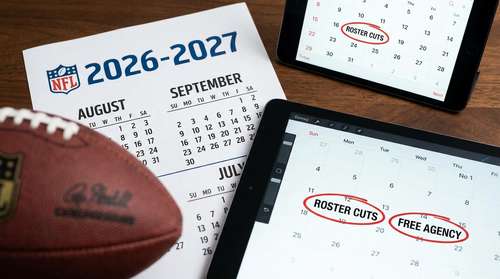
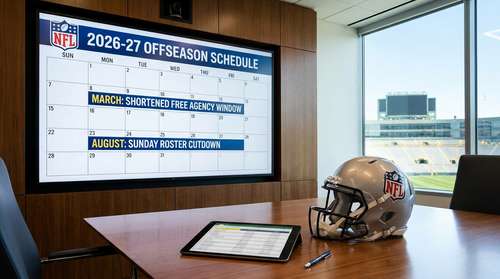
But Kraft's proposal comes with a critical caveat designed to appease a hesitant players' union: an NFL second bye week proposal. By integrating two rest weeks for all 32 franchises, the league would effectively stretch the regular-season calendar to 20 weeks. This extended timeframe would culminate in a massive television spectacle, permanently shifting Super Bowl Sunday to Presidents' Day weekend.
This calendar shift is not without its external casualties. Moving the Super Bowl to the third Sunday in February creates a direct, high-stakes collision with NASCAR's crown jewel, the Daytona 500. Despite the looming ratings war with motorsports, network executives and NFL owners view the three-day holiday weekend as the ultimate maximization of the Super Bowl's cultural footprint.
Brandon Beane Champions NFL Roster Size Changes
Adding an 18th game isn't just a scheduling puzzle; it constitutes a physical gauntlet. Player safety remains the primary roadblock to any NFL schedule expansion 2027 aspirations. Addressing the media on Monday in Phoenix, Buffalo Bills General Manager Brandon Beane made it explicitly clear that adding another high-impact game requires fundamental structural adjustments to team depth charts.
"I think you would have to talk about expanding rosters if we're going to eighteen games," Beane stated during the meetings. He specifically pointed to the limitations of the current 53-man active roster and the restrictive game-day limits. "Right now, we're 48 players on game day. I personally am pushing for us to hopefully get more at some point... from 48 to 50 or north of 50 to be able to accommodate another game".
These proposed NFL roster size changes are rapidly gaining traction among other front offices. General managers across the league recognize that surviving a 20-week gauntlet requires significantly deeper benches to mitigate the inevitable late-season attrition. Expanding the active roster would not only protect star players but also provide more opportunities for developmental talent to stay within team ecosystems.
The Global Catalyst: NFL International Games Expansion
The financial windfall of an 18th game is inextricably linked to Commissioner Roger Goodell’s vision for global dominance. The 2026 season already boasts a record nine international matchups, including the league's highly anticipated first regular-season foray into Australia. However, an 18-game format is the linchpin for the ultimate NFL international games expansion.
With an odd number of 17 games, competitive imbalance occurs because half the league gets an extra home game. With 18 games, the scheduling math finally achieves a perfect symmetry. Kraft and Goodell envision a mandate where all 32 teams play at least one neutral-site international game every single season. This would leave each franchise with exactly eight home games and eight away games, ensuring absolute competitive equity while rapidly accelerating the NFL's footprint in European, South American, and Oceanic markets.
Super Bowl Delays and the 2027 Timeline
While the momentum is palpable, implementing this seismic shift involves untangling a complex web of logistical hurdles. The current collective bargaining agreement (CBA) runs through the 2030 season, but reports indicate that owners are preparing to bring an official proposal to the NFLPA within the next 12 to 18 months, potentially targeting a 2027 rollout. Gaining union approval will require substantial concessions, particularly regarding the revenue split. The players currently receive a set percentage of league revenues, but adding a highly lucrative 18th game means the union will likely demand a larger piece of the financial pie in exchange for the added physical toll.
In preparation, the league is deliberately maneuvering its future championship venues to accommodate the mid-February date shift. During the Phoenix summit, owners are formalizing future host cities, with SoFi Stadium in Inglewood locked for 2027, Atlanta’s Mercedes-Benz Stadium for 2028, and Las Vegas's Allegiant Stadium slated for approval for Super Bowl LXIII in 2029. Yet, the exact dates for these future Super Bowls remain strategically fluid. The league is intentionally building flexibility into its future stadium and broadcast contracts, ensuring that when the 18-game schedule officially drops, the host cities are prepared for the new timeline.
As the 2026 meetings wrap up this week in Arizona, the writing is on the wall. The jump to 18 games is no longer a question of "if," but "when". With Kraft defining the structural blueprint, executives like Beane laying down the operational prerequisites, and global expansion demanding a balanced schedule, the NFL is methodically paving the way for the most significant transformation in modern professional football history.