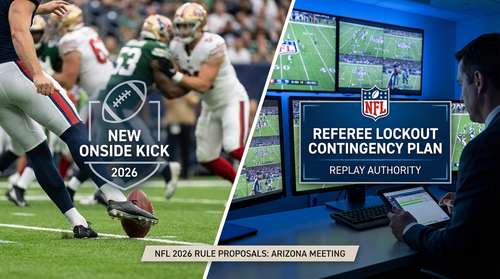
As the football world turns its attention to the desert this week, a massive cloud of uncertainty looms over the league's officiating future. Ahead of the NFL annual meeting Arizona, the league's front office has unveiled a slate of transformative ideas that could permanently alter the fabric of game day. The highly anticipated NFL rule changes 2026 are officially on the table, and they feature a radical departure from traditional special teams logic alongside an unprecedented, centralized safety net designed to mitigate a potential labor dispute.
The Referee Lockout Contingency Plan
The collective bargaining agreement between the league and the NFL Referees Association is rapidly approaching its expiration at the end of May. With negotiations reportedly stalling and the very real specter of a work stoppage growing, the NFL competition committee proposals include a drastic, one-year-only measure designed to prevent prime-time officiating disasters.
Should the league be forced to rely on replacement officials to start the season—a scenario that still haunts fans who lived through the infamous 2012 referee strike—the proposal would grant unprecedented NFL replay center authority. Specifically, the rule would allow the NFL officiating department 2026 headquarters in New York to step in and correct "clear and obvious misses" made by on-field personnel if those errors significantly impact the competitive balance of the game.
This NFL referee lockout contingency is a massive philosophical shift. Historically, the league has been hesitant to let an eye in the sky micromanage live play, fearing it would slow down the product. However, the 2012 lockout, which culminated in the disastrous "Fail Mary" call between the Packers and Seahawks, proved that inexperienced replacement referees can compromise the integrity of the sport. Empowering New York to act as a fail-safe ensures that if minor league officials are thrust onto the field this September, glaring administrative or judgment mistakes won't dictate the outcome of high-stakes matchups.
A Landmark Shift: The New NFL Onside Kick Rule
Beyond the labor dispute preparations, the most jarring tactical shift on the docket revolves around special teams. The committee has proposed a complete overhaul of the NFL onside kick rule, stripping away the highly restrictive conditions implemented over the last few seasons.
Currently, teams are only permitted to attempt an onside kick in the fourth quarter, and only if they are actively trailing. The new proposal would permit the kicking team to declare an onside kick at literally any time during the game, regardless of the score or the quarter.
Think about the strategic ripple effects. In recent years, onside kick recovery rates plummeted to historic lows as the league restricted running starts for player safety, making the play heavily predictable. By removing the fourth-quarter mandate, the element of surprise is entirely restored. A head coach could decide to steal a possession on the opening kickoff, or catch a reeling opponent sleeping after taking a sudden 14-0 lead in the first quarter. Coaches who thrive on aggressive analytics and momentum swings will undoubtedly weaponize this reinstated tactical freedom.
Additional Special Teams Tweaks
The 2026 docket isn't stopping there when it comes to the kicking game. The committee is also looking to eliminate the incentive for a kicking team to intentionally boot the ball out of bounds when kicking off from the 50-yard line—a scenario that often occurs following penalty yardage applied to the kickoff. Furthermore, they plan to modify kickoff alignment requirements for receiving team players in the setup zone to further enhance player safety.
Expanding the Eye in the Sky for Player Discipline
While the media focus remains largely on the lockout contingency and special teams, another notable proposal seeks to modernize how the league handles player ejections. The committee wants to allow league personnel to consult directly with on-field officials regarding disqualifications for both flagrant football acts and non-football acts, even without a penalty flag being explicitly thrown on the field.
This means if a player commits a blatant post-play cheap shot that the live crew somehow misses in the chaos of the scrum, the replay center can immediately radio down and ensure the offending player is ejected. It is yet another clear indicator that the league is prioritizing getting the call right by leveraging available technology and centralized oversight.
Other Notable Resolutions on the Table
In addition to the competition committee's five major playing rules, two club-submitted resolutions will be voted upon. The Cleveland Browns have proposed expanding the window for trading draft picks from three years to five years into the future, arguing it would provide front offices with greater roster-building flexibility. Meanwhile, the Pittsburgh Steelers proposed making permanent a 2025 rule change that allows teams to have limited video or phone contact with prospective unrestricted free agents during the pre-agency negotiation window.
All Eyes on the NFL Annual Meeting in Arizona
None of these proposals are set in stone quite yet. For any of these modifications to become official league policy, they must secure a 75 percent approval rate, meaning at least 24 of the 32 club owners need to vote in favor.
When owners, general managers, and head coaches convene from March 29 to April 1 in Phoenix, the debates will be intense. The looming threat of a referee strike has undeniably accelerated the league's willingness to expand centralized replay powers. Whether the owners embrace this temporary safety net—and the aggressive new onside kick philosophy—will ultimately shape the tactical landscape of the upcoming NFL season.