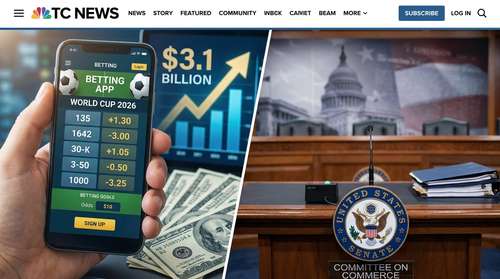
The stakes have never been higher for North American soccer fans or the lawmakers tasked with regulating their wagers. Leading industry analysts project that Americans will risk a staggering $3.1 billion on the upcoming tournament, fundamentally shifting the landscape of 2026 World Cup betting odds. With the event returning to the United States, Canada, and Mexico, this massive financial windfall nearly doubles the legal handle of the most recent Super Bowl. Yet, as sportsbooks prepare for unprecedented action, Washington is aggressively scrutinizing the rapidly expanding market.
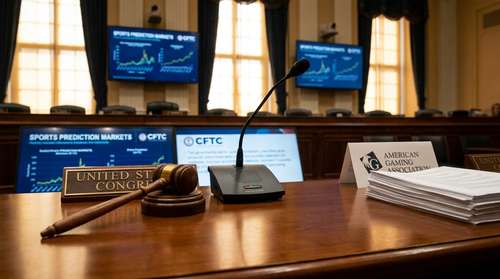
Today, May 26, the Senate Commerce Subcommittee on Consumer Protection, Technology, and Data Privacy convened a high-stakes sports betting integrity hearing titled "No Sure Bets: Protecting Sports Integrity in America". The proceedings highlight a growing tension between a booming domestic gambling industry and the lawmakers scrambling to police it.
Inside the Record-Breaking World Cup 2026 Gambling Handle
The sheer scale of the upcoming tournament explains the historic betting forecasts. Expanding for the first time to 48 teams and 104 matches, the extended competition offers more prime-time broadcasts for North American audiences than ever before. According to early estimates from Bookies.com and Deutsche Bank analysts, the traditional World Cup 2026 gambling handle is expected to hit $3.1 billion. That figure sharply eclipses the roughly $1.8 billion legally wagered by Americans during the 2022 tournament in Qatar.
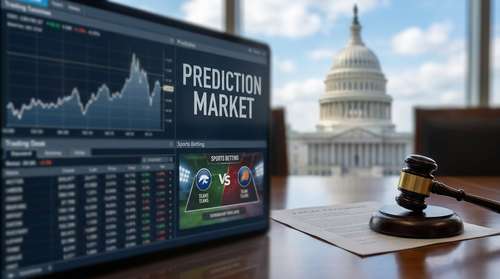
But traditional sportsbooks only tell half the story. The explosion of prediction markets like Kalshi and Polymarket threatens to rewrite the playbook for soccer betting predictions 2026. Forecasters anticipate these derivative trading platforms will handle an additional $2.4 billion in event contracts. Since the last World Cup, prediction platforms have aggressively moved into sports, effectively functioning as parallel, loosely regulated wagering networks.
The "No Sure Bets" Hearing Takes on Market Vulnerabilities
The convergence of staggering financial projections and a string of recent athletic scandals set the stage for today's US Senate sports betting inquiry. Chaired by Senator Marsha Blackburn (R-Tenn), the committee called a diverse roster of witnesses, including American Gaming Association (AGA) President Bill Miller and Public Health Advocacy Institute Director Dr. Harry Levant.
Lawmakers zeroed in on the blurred lines separating traditional betting from prediction markets. Miller delivered a sharp critique of event contract platforms, arguing they operate as "backdoor betting operations" that bypass state-level gaming oversight. He noted that sports trading on Kalshi, which accounted for virtually nothing two years ago, now dominates the platform's volume. Conversely, public health advocates like Dr. Levant warned that partnerships between professional leagues and major data providers have commodified game integrity to push highly addictive micro-bets onto fans.
Recent Scandals Fuel Regulatory Urgency
The urgency on Capitol Hill is palpable. Recent controversies—ranging from an NBA assistant coach pleading guilty to leaking injury information to major league baseball pitch-rigging charges—have forced legislators to confront whether current safeguards actually work. Lawmakers also raised severe concerns regarding the targeted advertising of gambling products to minors through social media influencers, highlighting a critical blind spot in current federal oversight.
Evolving FIFA World Cup Sportsbook Trends
As regulatory battles unfold in Washington, operators are racing to capitalize on shifting FIFA World Cup sportsbook trends. With 39 states and Washington D.C. now operating under frameworks for legal sports wagering USA, roughly 80% of the adult population has access to regulated betting. This represents a market maturity that simply did not exist during the last World Cup.
You can expect operators to heavily push live, in-game betting—or micro-betting—as the primary driver of engagement this summer. Because the matches take place in favorable time zones across the Americas, sportsbooks are preparing infrastructure to handle massive influxes of real-time wagers. From predicting the next throw-in to calling a specific player's golden boot chances, the depth of available markets will be unprecedented.
While Washington debates whether federal intervention is necessary to protect the sanctity of the sport, the betting public shows no signs of slowing down. The impending $3.1 billion wave of wagers guarantees that the 2026 World Cup will not just be a defining moment for North American soccer, but a critical stress test for the American sports betting industry.