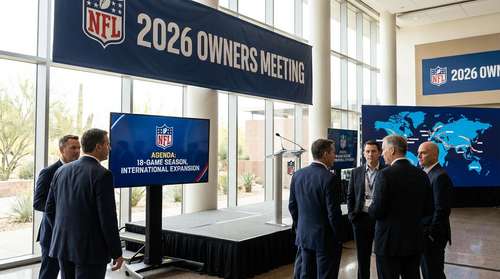
The landscape of professional football is on the brink of a monumental shift. As league executives, coaches, and general managers gather in Phoenix, Arizona, for the ongoing NFL owners meeting 2026, a massive overhaul of the league's calendar is dominating the conversation. Front and center is the aggressive push for an NFL 18-game season, coupled with a groundbreaking NFL international games expansion that would guarantee every franchise plays overseas annually. With sweeping proposals on the table—including a controversial shift in NFL draft pick trading rules—this week's summit is poised to redefine how the sport is managed, played, and consumed on a global scale.
The annual three-day summit, wrapping up on March 31, serves as the primary battleground for the league's competitive and financial trajectory. While routine bylaw adjustments and officiating contingencies are standard fare, the sheer magnitude of this year's agenda has established a distinctly urgent tone among the 32 ownership groups.
The Inevitable Push for an NFL 18-Game Season
The drumbeat for an extended regular season has grown deafening over the past few months. Momentum for an NFL 18-game season reached a boiling point when New England Patriots owner Robert Kraft made his intentions clear, publicly stating that ownership would push like the dickens to secure the extra matchup. The framework currently circulating the halls of the Arizona resort would expand the regular season from 17 to 18 games while trimming the preseason down to just two exhibition contests.
However, recent Roger Goodell news indicates the commissioner is maintaining a more measured public posture. Addressing the media ahead of the summit, Goodell pushed back on the narrative that the extension is a foregone conclusion. He emphasized that expanding the calendar requires intricate negotiations with the NFL Players Association (NFLPA), especially given the impending expiration of the current collective bargaining agreement. The league recognizes the astronomical financial upside of an 18th television broadcast window, but securing the players' union approval remains the ultimate roadblock.
Balancing Growth with NFL Player Safety Rules
You cannot simply add more brutal collisions to the professional calendar without addressing the severe physical toll on the athletes. A critical component of the proposed NFL schedule change 2026 is the introduction of a mandatory second bye week. Revamping NFL player safety rules is the only viable path to gaining union support. An 18-game gauntlet stretched over 20 weeks demands larger roster sizes, revised injured reserve designations, and smarter travel scheduling to ensure adequate recovery windows. For the athletes putting their bodies on the line, the extra bye week is not just a concession—it is a physiological necessity.
Massive NFL International Games Expansion
Tied directly to the 18-game proposal is a radical NFL international games expansion. The current blueprint guarantees that all 32 franchises will play at least one international game every single year, swelling the overseas schedule to 16 games annually.
The league has already planted flags in London, Munich, and São Paulo, and the 2026 slate introduces massive new frontiers. The Los Angeles Rams are scheduled to host a highly anticipated game in Melbourne, Australia, while the New Orleans Saints will play the NFL's first-ever regular-season matchup in Paris. Goodell has openly confirmed that reaching 16 international games is the league's ultimate target. This aggressive global strategy transforms foreign markets from novelty stops into foundational pillars of the league's long-term financial growth.
Revolutionary NFL Draft Pick Trading Rules Proposed
Off the field, the mechanics of roster building are facing an equally disruptive revolution. The Cleveland Browns, with vocal backing from the Los Angeles Rams, have formally proposed a dramatic alteration to NFL draft pick trading rules. Currently, front offices are only permitted to trade draft capital up to three years into the future. The new proposal would extend that window to a massive five years.
If the required 24 owners vote to ratify this measure, the trade market will immediately explode. The timing of the proposal is no coincidence; the league has already seen a frantic pace of 18 trades executed in just the first eight days of the new league year. Extending the trade window to five years completely changes the calculus of franchise team-building. It allows general managers to leverage future assets for blockbuster acquisitions that are currently impossible under league bylaws, paving the way for aggressive all-in strategies with unprecedented long-term risk. Speculation is already swirling in Phoenix that teams are eyeing this rule change to stockpile ammunition for the highly anticipated 2027 draft class.
Officiating Contingencies and the Road Ahead
Beyond the schedule and roster building, owners are also tackling immediate operational issues. With the NFL Referees Association's collective bargaining agreement expiring on May 31, the competition committee has drafted contingency plans. These include expanding the authority of the New York replay center to correct missed calls if replacement officials are required on the field this fall.
As the meetings conclude this week, the sheer scale of these proposals signals a league refusing to rest on its laurels. Between the looming NFL schedule change 2026, the global footprint expansion, and the financial ramifications of an 18-game television package, the sport is evolving faster than ever. While the expanded schedule and trade rule amendments still face union hurdles and ownership voting thresholds, the overarching trajectory is undeniable. The decisions debated in Arizona over these three days will dictate the rhythm of the football calendar for the next decade.