The landscape of professional football is officially shifting. Coming out of the NFL annual meeting in Arizona this week, league owners have approved a sweeping series of adjustments that will fundamentally alter game management. Headlining the NFL rule changes 2026 docket is a radical revamp of onside kick rules and a historic, one-year contingency plan granting unprecedented authority to the league's officiating headquarters.
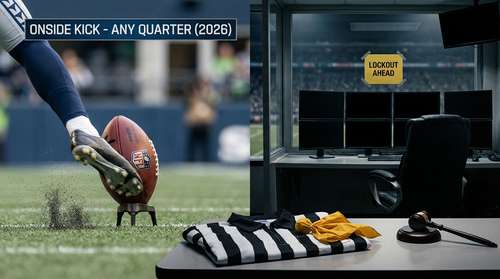
With the collective bargaining agreement between the league and the NFL Referees Association set to expire on May 31, executives are bracing for a potential NFL referee lockout. To mitigate disaster if replacement officials take the field this fall, the competition committee successfully pushed through a massive game officiating overhaul. Throw in total freedom for special teams coordinators to attempt onside kicks whenever they please, and the upcoming campaign is already shaping up to be wildly unpredictable.
Onside Kicks Unleashed: A Strategic Revolution
For decades, the onside kick has been strictly a desperation maneuver. When the dynamic kickoff format debuted, the league initially restricted these attempts to the fourth quarter for trailing teams only. Last year, the competition committee loosened the reins, allowing a trailing squad to declare an attempt at any point in the game.
Now, the training wheels are completely off. The updated onside kick rules permit the kicking team to declare an attempt at any time, regardless of the score. Whether a team is trailing, tied, or even nursing a multi-score lead, head coaches can deploy the tactic to steal an extra possession.
Competition committee chair Rich McKay recognized that situational football sometimes demands an aggressive approach even when a team isn't losing. "Before, the onside kick used to provide that you can only kick it if you were behind or tied," McKay told reporters. "And so we just eliminated that". The only remaining caveat is that the kicking team must still declare their intention to attempt the onside kick in advance, maintaining the safety protocols established by the dynamic kickoff framework. Imagine a scenario where a team is up by three points with two minutes remaining. Instead of kicking deep and relying on their defense, a coach with a highly efficient special teams unit could risk an onside kick to seal the victory right then and there.
Emergency Replay Center Oversight Amid Lockout Fears
While special teams adjustments dominated the on-field strategy discussions, labor disputes loomed large over the boardroom. The current CBA with the NFL Referees Association runs out at the end of May, and negotiations have reportedly stalled over pay and benefits. The league is already moving forward with plans to hire and train replacement officials over the summer.
The stakes of this collective bargaining agreement cannot be overstated. When the league previously utilized replacement officials in 2012, the situation devolved into chaos, punctuated by the infamous "Fail Mary" touchdown that dominated national headlines and forced a quick resolution to the strike. To protect the integrity of the game, owners overwhelmingly approved a one-year contingency measure for enhanced replay center oversight.
If a work stoppage forces replacement crews into action, the officiating department in New York will have the power to intervene and correct "clear and obvious mistakes" made by on-field officials. This emergency rule allows the replay command center to advise on missed roughing the passer penalties, intentional grounding, and other major infractions that impact the game's outcome. It represents a massive, albeit temporary, safety net for the sport's officiating mechanics.
The "DK Metcalf Rule" Expands Ejection Powers
The expansion of New York's authority doesn't stop at corrected penalty calls. Owners also passed a permanent amendment allowing league personnel to consult with on-field officials regarding player disqualifications for both flagrant football and non-football acts—even if a flag wasn't initially thrown on the play.
This specific adjustment was heavily influenced by a high-profile incident involving Pittsburgh receiver DK Metcalf last season. During a tense road game in Detroit, Metcalf engaged in a physical altercation with a heckling fan. Because the on-field officials missed the swipe in real-time and didn't throw a penalty flag, the replay center was severely handicapped by the old rulebook and couldn't eject him from the contest. Though he was eventually suspended by the league for two games, Metcalf was allowed to finish the game. Under the new 2026 framework, New York can drop a flag from the sky and issue an immediate ejection for such egregious actions.
Closing the 50-Yard Line Loophole
Beyond the headline-grabbing changes, the competition committee also voted to close a frustrating special teams loophole. Last season, if a personal foul penalty moved a kickoff up to the 50-yard line, kicking teams were actually mathematically incentivized to intentionally boot the ball out of bounds. The old rules stipulated that an out-of-bounds kick from midfield spotted the ball at the 25-yard line, which was a significantly better outcome for the kicking team than risking a dynamic return or giving the receiving team a standard touchback at the 35-yard line.
Owners have now eliminated that perverse incentive entirely. Moving forward, a kickoff from the 50-yard line that results in a touchback will automatically place the ball at the 20-yard line. This minor but highly crucial tweak ensures that teams will aim for a deep, in-bounds kick rather than exploiting a mathematical quirk in the rulebook to gain a cheap field position advantage.
Looking Ahead to the Fall
As we build toward a highly anticipated 2026 NFL season preview, these regulatory shifts guarantee a different product on Sundays. Coaches will have a wider playbook for special teams trickery, while the specter of replacement referees will test the limits of the league's centralized replay infrastructure. Whether the players' union and the referees can reach an agreement before training camp remains the biggest storyline of the offseason, but the NFL has made it crystal clear: the games will go on, and the rules are adapting to meet the moment.