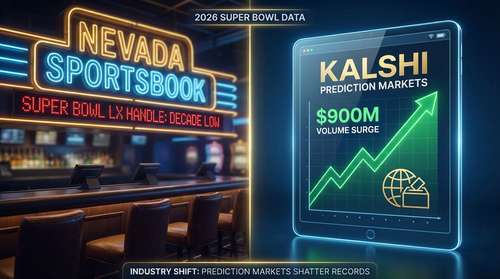
In what industry analysts are already calling the "Great Decoupling" of the American wagering landscape, finalized handle reports for February 15, 2026, reveal a historic changing of the guard. While traditional Nevada sportsbooks reported a decade-low handle of $133.8 million for Super Bowl LX, peer-to-peer prediction markets like Kalshi and Polymarket surged to unprecedented heights, processing nearly $900 million in single-day volume. This seismic shift marks the moment where prediction markets sports betting transitioned from a niche financial experiment to the dominant force in high-volume event wagering.
The Numbers: A Tale of Two Markets
The contrast between the legacy betting capital of the world and the digital frontier could not be starker. According to the Nevada Gaming Control Board, the $133.8 million wagered on the Seattle Seahawks' 29-13 victory over the New England Patriots represents an 11.7% decline year-over-year and the lowest Super Bowl handle since 2016. Traditional sportsbooks struggled to engage bettors during a defensive-minded "snoozer" that saw Seattle take a 9-0 halftime lead and never look back.
Conversely, the Kalshi Super Bowl volume 2026 data tells a completely different story. Unencumbered by the need for high-scoring entertainment to drive engagement, traders flocked to exchanges to profit from the game's grinding pace. Combined with Polymarket's liquidity, the total exchange volume eclipsed the output of every physical sportsbook on the Las Vegas Strip combined. The message is clear: the modern bettor is no longer just a fan hoping for excitement—they are an "information trader" seeking value.
The Death of the Vig: Why Bettors Are Switching
The primary driver behind this exodus is simple economics. For decades, traditional sportsbooks have operated on a high-margin model, charging a "vig" (vigorish) that essentially taxes every wager. In 2026, sophisticated users are increasingly refusing to pay this retail markup. On platforms like Kalshi, which operates as a federally regulated exchange, users trade directly with one another. This peer-to-peer structure eliminates the house edge, allowing for pricing that traditional books simply cannot match.
During Super Bowl LX, while a standard sportsbook might have offered -110 odds (implied 52.4% probability) on a coin-flip proposition, prediction markets offered contracts priced at 50 cents on the dollar with minimal transaction fees. For high-volume traders, this difference between a 1.90 payout and a 1.99 payout is the mathematical difference between a hobby and a profession. This efficiency is the core reason why sports betting industry trends are aggressively breaking toward exchange models.
Micro-Markets and Liquidity
The flexibility of the exchange model also shone during the game's sluggish second half. While live betting handles at major operators like DraftKings and FanDuel dipped as the Patriots' offense stalled, prediction markets saw furious trading on micro-outcomes—such as the exact number of punts in the third quarter or the likelihood of a defensive touchdown. These "outcome contracts" remained liquid and active even when the game result felt like a foregone conclusion.
Regulatory Battlegrounds: CFTC vs. State Commissions
This massive redistribution of capital has not gone unnoticed by regulators. The surge in Polymarket sports wagering and Kalshi's dominance comes amidst a fierce legal tug-of-war. While Kalshi operates under the oversight of the Commodity Futures Trading Commission (CFTC), state regulators in jurisdictions like Nevada and Massachusetts have fought to classify these contracts as sports gambling subject to local licensure.
Despite these challenges, the 2026 data suggests that the consumer has already made their choice. The "borderless" nature of these digital markets—accessible to anyone aged 18+ in most states—has created a legal betting exchange USA framework that bypasses the fragmented state-by-state rollout of traditional sports betting. As witnessed this weekend, geofencing efforts in states like Nevada did little to stem the overall national tide, as traders in 40+ other states drove liquidity to record levels.
The Future of Wagering
As the dust settles on Super Bowl LX, the industry faces an existential question. The decade-low Nevada sports betting handle serves as a warning sign that the old model of high-vig, entertainment-focused betting is losing its grip on the next generation. The future belongs to platforms that treat sports outcomes as asset classes rather than casino games.
With Super Bowl LX betting results validating the exchange model at a massive scale, 2026 will likely be remembered as the year the sportsbook finally lost its monopoly on the American gambler. The house doesn't always win—especially when the players decide to become the house themselves.