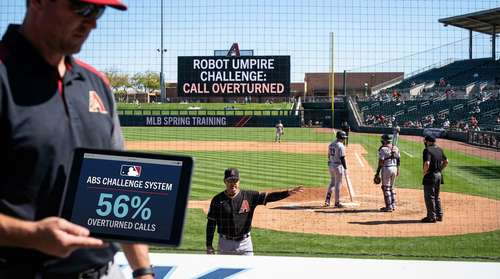
The era of MLB robot umpires 2026 has officially arrived, and if the first day of action is any indication, the game of baseball is about to change forever. Major League Baseball’s Automated Ball-Strike (ABS) Challenge System made its highly anticipated debut during Friday's opening Spring Training games, delivering a shocking statistic that has front offices scrambling: players successfully overturned 56.5% of challenged calls. The high success rate suggests that human umpire accuracy may be under more scrutiny than ever as the league prepares for a full rollout on Opening Day.
The Numbers: Human Umpires Struggle in ABS Debut
Friday’s slate of Cactus and Grapefruit League games wasn't just about knocking off the rust for pitchers and hitters; it was the first real-world stress test for the Automated Ball-Strike system at the major league level. According to initial data released by MLB, players initiated 23 challenges across the five opening games. Of those, a staggering 13 calls were overturned, resulting in a 56.5% success rate for the challengers.
This overturn rate is significantly higher than the numbers seen during minor league testing, where success rates generally hovered near 50%. The immediate impact was felt across the league, with the ABS challenge system results confirming that players have a keen eye for the strike zone—perhaps keener than the umpires themselves in these early exhibitions. For fans and bettors wondering about MLB umpire accuracy 2026, these early figures suggest that the "human element" is about to get a major digital correction.
The Arizona Anomaly: A Glimpse of the Future
While some games saw quiet implementation, the matchup between the Arizona Diamondbacks and Colorado Rockies offered a chaotic preview of the new strategic landscape. In that single contest, teams combined for seven challenges, with six of them resulting in overturned calls. The Diamondbacks were particularly ruthless, going 4-for-5 on their challenges, proving that the system can be weaponized to extend at-bats and squeeze pitchers.
Cowser Makes History, But Not Headlines
The distinction of the first-ever ABS challenge in MLB history went to Baltimore Orioles outfielder Colton Cowser. In the bottom of the second inning against the Yankees, Cowser tapped his helmet to contest a called strike. While the system upheld the umpire's call in this specific instance, the moment marked a pivotal shift in baseball rule changes 2026. It demonstrated the seamless speed of the technology, with the decision rendered in under 15 seconds—far faster than the video reviews fans are accustomed to.
Strategic Shift: Weaponizing the Challenge System
The high overturn rate is forcing managers to rethink their in-game management immediately. Under the 2026 rules, each team is allotted two challenges per game. Crucially, if a challenge is successful, the team retains it. This "retain-if-correct" mechanic means that a team with a sharp eye could theoretically challenge incorrectly called pitches all game long, keeping the pressure on the home plate umpire.
"It changes the leverage completely," said one National League bench coach after Friday's action. "If you know the ump is widening the zone, you don't just complain anymore. You fix it." This strategic layer adds a new dimension to MLB Spring Training 2026, as teams are now using these exhibition games not just to evaluate talent, but to train players on when to tap their helmet. The days of arguing with the umpire are fading; the day of correcting them with millimeter-precision technology is here.
What This Means for Opening Day 2026
As the Cactus League highlights today continue to roll in, the narrative is shifting from "will it work?" to "how much will it change the game?" The 56% overturn rate is a wake-up call for the league's umpiring crews. While the sample size is small—just one day of games—the data reinforces the argument that a fully automated zone might be the eventual endgame. However, for 2026, the challenge system strikes a balance, keeping the human umpire behind the plate while providing a safety net for egregious misses.
For now, the robot umpires aren't calling every pitch, but they are certainly having the final say. As Spring Training progresses, expect teams to become even more aggressive with their challenges, potentially pushing that overturn rate even higher. The message from Day 1 is clear: the zone is defined, the cameras are rolling, and the margin for error has never been smaller.