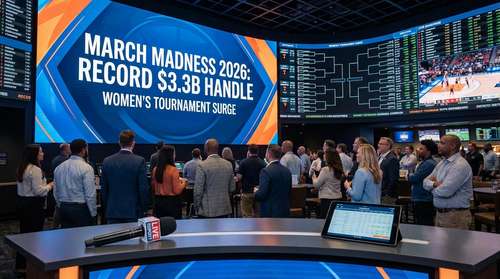
The madness of March has officially arrived, bringing an unprecedented avalanche of wagers to the hardwood. As fans scramble to lock in their picks and find the best lines, the landscape for March Madness betting 2026 is shattering previous ceilings. The American Gaming Association projects a staggering $3.3 billion will be wagered legally across the men’s and women’s tournaments this spring. This reflects a massive 54% jump over the last three years, propelled by newly activated state markets, surging fan interest, and an absolute explosion in prediction market activity. The days of simple office pools have rapidly evolved into a multi-billion dollar financial ecosystem.
Analyzing the $3.3 Billion NCAA Tournament Handle
The total NCAA tournament handle has entered entirely uncharted territory. According to the newly released AGA sports betting report, regulated U.S. markets are preparing for record-breaking consumer engagement. Bill Miller, AGA President and CEO, noted that this momentum stems from soaring consumer confidence and a vastly expanded regulated footprint across the country.
While last year's baseline sat at $3.1 billion, the continuous legalization sweep has poured fresh capital into the industry. It is critical to note that the $3.3 billion figure solely represents traditional, licensed sportsbooks. It deliberately excludes the shadow of emerging prediction platforms and unregulated peer-to-peer networks. H2 Gaming Capital, an independent research firm, suggests that when factoring in all channels, the total money changing hands could easily exceed $4 billion, dwarfing the handle of the Super Bowl.
The Dawn of Legal Sportsbooks Missouri
One of the most significant catalysts for this year’s handle boom is the newly activated Midwestern frontier. The highly anticipated launch of legal sportsbooks Missouri has unleashed a rabid fanbase that previously crossed state lines or relied on offshore alternatives to place their bets. For years, neighboring states like Illinois and Kansas siphoned millions in tax revenue from Missouri residents traveling to place wagers.
By capturing the action from Columbia to Kansas City, local operators are reporting exceptional early deposit metrics. This regional activation is vital for the overall national handle. Missouri brings several major college programs and a deeply entrenched sports culture directly into the regulated fold. Sportsbooks are offering aggressive promotional tie-ins to capture this fresh demographic, creating an immediate revenue spike just in time for the opening tip-off.
Unprecedented Women's Basketball Betting Trends
Perhaps the most compelling storyline of the 2026 tournament isn't just the sheer volume of cash, but exactly where it is flowing. The women's basketball betting trends have experienced a seismic shift, recording an astonishing 10x spike in wagering interest since 2023. What was once an afterthought for oddsmakers has blossomed into a marquee event.
Superstar talent, prime-time national broadcasting slots, and increasingly competitive parity have transformed the women’s bracket into a premier betting attraction. Operators are responding aggressively by offering expansive prop markets and live betting options that were practically non-existent just three seasons ago. Bettors are heavily targeting individual player points, rebounds, and dynamic in-game spreads. This is no longer viewed as a secondary market; the women's tournament is now a primary driver of industry growth, pulling in a younger, highly engaged demographic.
Prediction Market Regulations and Advertising Wars
While traditional sportsbooks celebrate record revenue projections, a fierce battle for market share is unfolding just outside the standard regulatory boundaries. The AGA recently sounded the alarm on the surge of contract-trading platforms. Instead of traditional odds, these platforms allow users to trade 'yes/no' shares on game outcomes. In the first two months of 2026 alone, prediction markets accounted for roughly 43% of all digital sports betting ad impressions in the United States.
This aggressive marketing push—which saw platforms like Kalshi generate 5.2 billion ad impressions compared to FanDuel's 2.9 billion—has sparked intense debates over prediction market regulations. Industry advocates argue these platforms often operate without standard responsible gaming messaging, prompting regulators in states like Massachusetts and Tennessee to issue cease-and-desist orders. The escalating tension between traditional oddsmakers and these prediction markets is rapidly redefining the competitive gambling landscape.
Strategizing Your March Madness Bracket Odds
For the everyday fan, the focus remains strictly on the hardwood and the precarious path to the Final Four. Analyzing the March Madness bracket odds has become a highly sophisticated endeavor, blending advanced analytics with traditional gut feelings. With the expanded betting menu available this year, you are no longer limited to merely picking outright winners or filling out a static piece of paper.
The explosion of micro-betting allows fans to wager on the next possession, individual player point totals, and specific matchup margins in real-time. Whether you are backing an underdog Cinderella story or trusting a perennial powerhouse, the sheer volume of available data means informed bettors have more leverage than ever before. Traditional bracket challenges are increasingly being supplemented by live parlays and futures bets. As the tournament tips off, the collision of massive betting volumes, new legal markets, and unprecedented accessibility promises to make this the most heavily scrutinized March in sports history.