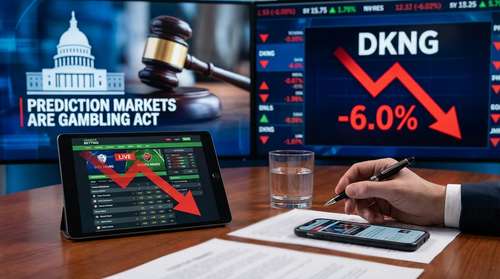
The introduction of a sweeping bipartisan Senate bill has sent a shockwave through the gaming sector this week, fundamentally reshaping the outlook for sports betting regulation in 2026. Designed to close a highly debated regulatory loophole, the newly proposed Prediction Markets Are Gambling Act targets platforms operating outside the traditional bounds of state gambling commissions. But what initially looked like a regulatory victory for established sportsbooks has quickly triggered a sharp reversal in the markets. The latest DraftKings stock news reveals a 6% slide to around $22 per share by Wednesday morning, as investors digest the reality that the legislation could inadvertently kneecap one of the company's most promising growth engines,.
The Prediction Markets Are Gambling Act Explained
Introduced on Monday, March 23, by Senators Adam Schiff (D-CA) and John Curtis (R-UT), the legislation takes direct aim at platforms operating under the oversight of the Commodity Futures Trading Commission (CFTC),. Over the past year, platforms have leveraged their federal registrations to offer event contract wagering in all 50 states, effectively bypassing localized licensing requirements and state gambling laws.
The bipartisan bill would amend the Commodity Exchange Act to explicitly prohibit CFTC-registered entities from listing contracts tied to sporting events, athletic competitions, or casino-style games like blackjack and video poker,.
"Sports prediction contracts are sports bets—just with a different name," Senator Schiff stated when announcing the legislation. Senator Curtis echoed the sentiment in a subsequent television appearance, asserting that if a product acts and looks like gambling, it is gambling. The core of the legislation highlights a growing conflict over federal vs state sports betting, prioritizing local jurisdiction and consumer protection over federal financial market rules,.
The Unintended Consequence: DraftKings Stock Slides
When the bill was first announced, traditional sports betting operators experienced an immediate market bump. DraftKings initially gapped up nearly 8% on Monday premarket, as Wall Street assumed the legislation would effectively serve as a Kalshi sports betting ban that would eliminate disruptive competitors eating into traditional sportsbook handles.
By Wednesday, however, the narrative shifted drastically. Traders realized that DraftKings has been heavily investing in its own CFTC-regulated event contracts division, known as DraftKings Predictions. CEO Jason Robins recently touted this segment as a massive, incremental opportunity capable of driving billions in future revenue,.
With the Senate bill threatening to outlaw all federally regulated sports event contracts, DraftKings found its own product squarely in the crosshairs. Consequently, DKNG shares dropped roughly 6%, settling near $22,. In contrast, competitors with minimal exposure to the prediction market space, such as Penn Entertainment, saw their stock remain essentially flat.
Explosive Growth and the Push for a Kalshi Sports Betting Ban
To understand why lawmakers are acting now, you only need to look at the staggering capital flowing through these exchanges. The Polymarket March Madness volume has already surged past $100 million in trading this month,. Earlier this year, Super Bowl-related contracts on prediction platforms cleared $1 billion in total volume.
This explosive growth has triggered fierce pushback from state regulators. Recently, Arizona filed criminal charges against Kalshi for allegedly operating an illegal gambling business, while Nevada secured a temporary restraining order blocking the platform from offering sports and election contracts,.
In response to the mounting legislative pressure, both Kalshi and Polymarket scrambled this week to implement emergency guardrails. The platforms announced proactive bans preventing athletes, referees, and political candidates from trading on events they are directly involved in—an acknowledgment of the insider trading concerns long voiced by critics.
A Threat to State Revenues and Oversight
Since the Supreme Court struck down PASPA in 2018, individual states have built robust, regulated gambling frameworks that generate significant tax revenue. Prediction markets circumvent this system entirely. By classifying their offerings as commodity futures, these exchanges avoid the heavy taxation, strict integrity monitoring, and rigorous licensing that standard sportsbooks endure,.
Lawmakers are now moving decisively to protect the localized system. Senator Schiff recently pointed to a highly accurate geopolitical trader on a blockchain platform as evidence of potential insider trading, highlighting the difficulty of enforcing integrity on decentralized exchanges. Meanwhile, Senator Curtis raised alarms about the moral hazard of allowing unregulated bets on amateur athletics, specifically warning of the dangers of allowing wagers on high school athlete injuries. Their united front signals that Congress is ready to step in and restore state sovereignty over sports wagering,.
What This Means for Sports Betting Regulation in 2026
The rapid introduction of this Senate bill marks a defining moment for the U.S. gaming industry. Whether the legislation passes smoothly or faces gridlock, it has permanently altered how investors and operators view the frontier of sports betting regulation 2026,.
For traditional operators, the next few months will require a delicate balancing act. Companies like DraftKings must defend their core state-licensed operations while figuring out how to salvage the lucrative event contract models they were hoping to scale nationwide. Meanwhile, the legal battles between state attorneys general and prediction market startups will likely escalate, forcing courts to finally define the boundary between a financial derivative and a traditional sports wager,.