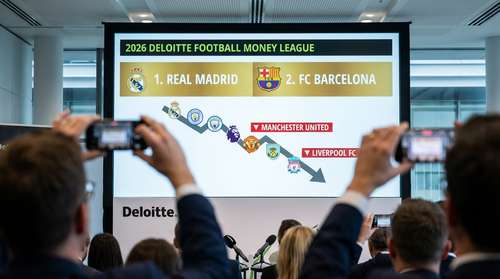
For the first time in nearly three decades, the financial stranglehold of the English Premier League has loosened. The 2026 Deloitte Football Money League, released Thursday, outlines a historic shift in global soccer economics: no English club appears in the top four. Real Madrid has retained its crown as the world’s highest-earning club for a third consecutive year, shattering records with a staggering revenue of €1.16 billion. Following closely is a resurgent FC Barcelona, whose financial recovery has propelled them to second place, signaling a new dawn for La Liga giants.
The Spanish Superpowers: A Commercial Masterclass
The headline story of the Deloitte Football Money League 2026 is undoubtedly the dominance of Spain's "Big Two." Real Madrid's financial engine is firing on all cylinders, driven by the completed renovation of the Santiago Bernabéu. The stadium is no longer just a football ground but a 365-day entertainment hub. Deloitte reports that Los Blancos generated €594 million in commercial revenue alone—a figure so immense that it would rank in the top 10 of the Money League on its own.
"Real Madrid has set a new benchmark for how football clubs can monetize their assets," notes the report. By hosting major concerts, NFL games, and corporate events, the club has future-proofed its revenue streams against on-pitch volatility. Meanwhile, FC Barcelona financial recovery stories have often focused on "levers," but the 2026 figures show sustainable growth. Generating €975 million, the Catalan giants have climbed back to second place, proving that their brand remains one of the most potent in world sports despite recent austerity measures.
Premier League Giants Slump: A Historic Low for Manchester United
While Spain celebrates, questions are mounting in England. The absence of Premier League teams in the top four—occupied by Real Madrid, Barcelona, Bayern Munich (€861m), and Paris Saint-Germain (€837m)—marks a significant regression. The most shocking development concerns Manchester United. once the undisputed kings of football finance. The Red Devils have plummeted to eighth place with revenues of €793 million, their lowest-ever ranking in the report's 29-year history.
The Manchester United revenue slump is attributed to a "perfect storm" of on-pitch underperformance and a failure to modernize revenue streams at the same pace as their European rivals. Missing out on the deep stages of the UEFA Champions League has severely impacted broadcast income, while Old Trafford's limitations compared to the modern Bernabéu or Tottenham Hotspur Stadium are becoming financially painful.
Manchester City also saw a decline, dropping from second to sixth (€829m). The Premier League vs La Liga finances debate has often centered on TV rights, but this year's data suggests that diversified commercial revenue is now the key differentiator at the elite level.
Liverpool FC: The Best of the British
Amidst the gloom for English clubs, Liverpool FC offers a beacon of smart strategy. The Reds have risen to fifth place (€836m), becoming the highest-ranked British club for the first time in the Money League's history. This success wasn't just about football; it was about maximizing Anfield. The expanded stadium capacity combined with a lucrative calendar of non-matchday events—including sold-out concerts by global superstars like Taylor Swift—boosted their commercial revenue by 7%.
For Liverpool, the strategy of expanding Anfield rather than building new has paid dividends, allowing them to leapfrog domestic rivals City and United. It serves as a lesson to the rest of the league: in the race to be one of the richest soccer clubs 2026, reliance on broadcast deals is no longer enough.
The €12 Billion Industry
Despite the shuffle at the top, the football industry as a whole continues to grow. The top 20 clubs generated a record €12.4 billion in 2024/25, an 11% increase from the previous year. However, the gap between the "super clubs" effectively utilizing their stadiums and those relying on traditional matchday income is widening.
Key Takeaways from the 2026 Report
- Real Madrid breaks the €1.1 billion barrier, setting a new world record.
- Commercial revenue is now the dominant income stream, overtaking broadcast rights for the top clubs.
- Manchester United falls out of the top 5 for the first time, signaling an urgent need for infrastructure investment.
- Bayern Munich and PSG capitalize on consistent domestic dominance and Champions League participation to lock out the top 4.
As the football world digests these figures, the message from the 2026 Money League is clear: the days of Premier League financial invincibility are over. To reclaim the throne, English clubs must look to Madrid and learn that a stadium is more than just a place to play on weekends—it's the engine room of a modern superclub.