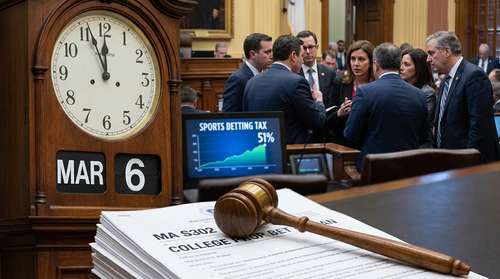
With the legislative clock winding down, tension is palpable inside the Massachusetts State House. Lawmakers are racing against a critical March 6 deadline to advance Massachusetts Bill S302, a sweeping piece of legislation that could fundamentally reshape the state’s sports betting landscape. At the heart of the bill is a controversial prohibition on individual player prop bets for college athletes—a market that the NCAA and former Governor-turned-NCAA President Charlie Baker have aggressively targeted to curb sports betting harassment.
Inside Bill S302: A Seismic Shift for Sportsbooks
Sponsored by Senator John Keenan, Bill S302 is far more than a simple tweak to existing regulations; it represents a complete overhaul of the framework established just three years ago. If passed, the bill would ban all proposition bets on collegiate athletes, aligning Massachusetts with states like Ohio, Vermont, and Louisiana, which have already enacted similar bans.
However, the college prop bet ban is just the tip of the iceberg. The legislation also proposes skyrocketing the tax rate on mobile sports betting operators from the current 20% to a staggering 51%, matching New York’s nation-high rate. Additionally, S302 seeks to eliminate VIP and host programs that incentivize high-volume betting and would ban sports wagering advertisements during televised live sporting events.
The NCAA's "Enough is Enough" Campaign
The push for NCAA betting regulations 2026 has reached a fever pitch, driven largely by the alarming rise in abuse directed at student-athletes. A recent NCAA study revealed that one in three high-profile college athletes has received betting-related harassment, ranging from social media slurs to direct death threats.
NCAA President Charlie Baker has been vocal about the dangers of "micro-betting"—wagers on individual plays or player stats—arguing that they turn teammates into commodities and fuel toxic behavior. "The data is clear," Baker noted in a recent statement urging states to adopt stricter controls. "When you allow bets on whether a 19-year-old hits a specific free throw, you are painting a target on their back."
Protecting Integrity Ahead of March Madness
The timing of the deadline is no coincidence. With the conference tournaments underway and the NCAA Tournament looming, regulators are desperate to implement safeguards before the explosion of March Madness betting trends takes over. In 2025, prop bets accounted for a significant portion of handle during the tournament, correlating with a spike in reported harassment incidents.
Industry Pushback: The Battle Over Revenue
While the moral argument for protecting athletes is gaining bipartisan traction, the economic implications of S302 have triggered fierce opposition from the gaming industry. Major operators warn that a 51% tax rate, combined with the removal of popular betting markets like individual player prop bets, could make the Massachusetts market commercially unviable.
Lobbyists argue that banning legal prop bets won't stop the activity but will instead push bettors toward unregulated offshore markets where there are zero consumer protections. They point to the revenue generated by these markets—often estimated at 10-15% of total collegiate handle—as vital for the state’s tax coffers.
What Happens After the March 6 Deadline?
The Joint Rule 10 reporting deadline on March 6 is a "put up or shut up" moment for the Joint Committee on Economic Development and Emerging Technologies. They must report the bill out favorably, ask for another extension, or let it die in committee. Given the high profile of the legalized sports gambling updates being proposed, political analysts believe an extension or a redrafted version is the most likely outcome, keeping the debate alive through the spring session.
For now, all eyes are on Beacon Hill. Whether S302 passes in its current draconian form or is watered down, the message to the industry is clear: the era of unrestricted growth for college sports betting in Massachusetts may be coming to an abrupt end.