
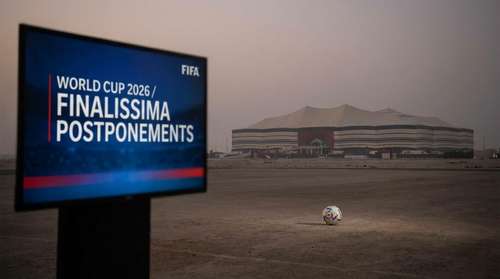
Major international soccer fixtures, including the highly anticipated Lionel Messi Finalissima 2026 clash and key AFC Champions League postponed matches, have been thrown into chaos following escalating geopolitical tensions in the Middle East. As of Tuesday, March 3, 2026, the Qatar Football Association has suspended all soccer activities indefinitely, casting doubt on the upcoming showdown between Argentina and Spain. Meanwhile, FIFA officials are scrambling to assess FIFA World Cup 2026 logistics as concerns grow over the participation of qualified nations like Iran amidst the deepening crisis.
Finalissima 2026: Messi vs. Yamal Showdown in Doha Indefinitely Delayed
The dream matchup between Lionel Messi’s World Cup-winning Argentina and Lamine Yamal’s Euro 2024 champion Spain is effectively on hold. Scheduled for March 27 at the Lusail Stadium in Doha, the Argentina vs Spain Qatar fixture—dubbed the "Finalissima"—has become the highest-profile casualty of the recent regional instability. Following confirmed airstrikes and subsequent airspace closures across the Gulf, the Qatar Football Association (QFA) announced a blanket suspension of all football tournaments and matches "until further notice."
Sources close to CONMEBOL and UEFA indicate that while cancellation is a last resort, finding an alternative venue on such short notice is logistically nearly impossible. "The priority is the safety of players and fans," a UEFA spokesperson stated late Monday. For Messi, now 38, this postponement threatens one of his final chances to lift another intercontinental trophy, while fans eagerly awaiting the generational clash with teenage sensation Yamal must wait as uncertainty looms.
AFC Champions League Postponed: Ronaldo and Al Nassr Grounded
The ripples of the conflict have paralyzed club football in the region. The Asian Football Confederation (AFC) has officially confirmed that all AFC Champions League postponed fixtures in the West Region will be rescheduled. This includes the high-stakes quarter-final tie between Cristiano Ronaldo’s Al Nassr and UAE side Al Wasl, originally set for this week in Dubai.
Cristiano Ronaldo Al Nassr news updates confirm that the Portuguese superstar and his team are currently unable to travel due to severe airspace restrictions over Saudi Arabia and the UAE. The AFC released a statement emphasizing that "matches involving clubs from the East Region will proceed," but the West Region's schedule remains in limbo. With airports in Dubai and Doha facing significant disruptions, the logistical nightmare for traveling teams has forced the AFC's hand, prioritizing player safety above the competition calendar.
World Cup 2026 Security Updates: Iran's Participation in Doubt
Perhaps the most significant long-term implication concerns the 2026 World Cup news. With the tournament in North America just months away, FIFA is facing a diplomatic and security crisis. Iran, having qualified for the tournament and drawn into Group G alongside Belgium, New Zealand, and Egypt, has signaled that its participation is now uncertain. Iranian Football Federation President Mehdi Taj told local reporters that "it is hard to look at the World Cup with hope" given the current hostilities.
FIFA Secretary General Mattias Grafström addressed the situation from Cardiff, stating, "We will monitor developments around all issues... our focus is on a safe World Cup with all teams participating." However, World Cup security updates suggest that FIFA is already exploring contingency plans. Article 6 of the World Cup regulations gives FIFA the discretion to replace a withdrawing nation or alter the group format. The prospect of an Iranian withdrawal—or potential visa complications for entering the United States—poses a severe test for FIFA World Cup 2026 logistics and the integrity of the group stage.
Logistical Nightmares and Global Travel Disruptions
Beyond the immediate fixture cancellations, the closure of key airspace corridors over Iran and the Gulf is wreaking havoc on global sports travel. Teams attempting to fly between Europe and Asia are facing rerouted flights and cancellations. For the World Cup hosts—United States, Mexico, and Canada—the unfolding situation demands urgent revisions to security protocols and visa processing for incoming delegations from affected regions. As the conflict evolves, the football world holds its breath, hoping for a resolution that allows the beautiful game to return to the pitch.