With just over 100 days until the opening kickoff of the 2026 FIFA World Cup, the tournament faces a "perfect storm" of logistical and security nightmares that threatens to derail the largest sporting event in history. A paralyzing 2026 World Cup government shutdown in the United States has frozen nearly $900 million in vital security aid, while a sudden explosion of cartel violence in Mexico has forced FIFA leadership into emergency damage control. For host cities from Seattle to Guadalajara, the clock is no longer just ticking—it is sounding an alarm.
Federal Funding Freeze: A "Catastrophic" Standoff
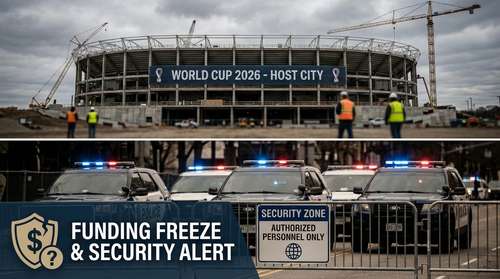
The immediate threat to the tournament’s viability lies in Washington, D.C., where a partial government shutdown involving the Department of Homeland Security (DHS) has left US host cities World Cup 2026 preparations in financial limbo. At the heart of the crisis is the suspension of the FIFA World Cup Grant Program, which was slated to deliver $625 million to 11 U.S. host cities, alongside an additional $250 million earmarked for critical counter-drone defense systems.
During a tense House Homeland Security Committee hearing on Tuesday, local officials described a grim reality. Ray Martinez, Chief Operating Officer of the Miami Host Committee, delivered a stark ultimatum to lawmakers, warning that his city faces a "drop-dead date" in just 30 days. "Without receiving this money, it could be catastrophic for our planning and coordination," Martinez testified, noting that Miami may be forced to cancel its planned Fan Fest events if the FIFA World Cup funding freeze isn't resolved by late March.
The situation is equally dire in the Northeast. Officials in Foxborough, Massachusetts—home to Gillette Stadium—have threatened to withhold the entertainment license required for the tournament unless a $7.8 million dispute over policing costs is settled. With federal purse strings drawn tight, local taxpayers are refusing to front the bill for a global event, creating a standoff that FIFA can ill afford this close to kickoff.
Mexico Security Crisis: Violence Rocks Guadalajara
While U.S. organizers battle red tape, their counterparts in Mexico are battling a surge in real-world violence. A 2026 World Cup security crisis erupted in Jalisco this week following the death of Nemesio Oseguera Cervantes, the notorious cartel leader known as "El Mencho," during a security operation on Sunday. The power vacuum triggered a wave of "narcobloqueos"—burning vehicle blockades—across Guadalajara, a key host city scheduled to stage four matches at the Estadio Akron.
The chaos forced the postponement of four Liga MX matches and prompted the U.S. State Department to issue shelter-in-place advisories for employees in the region. The optics of burning buses just miles from World Cup venues have fueled 2026 World Cup relocation rumors, with speculators questioning whether Guadalajara can guarantee the safety of hundreds of thousands of international visitors.
In response to the unrest, FIFA President Gianni Infantino issued a Mexico statement expressing "total confidence" in the local government's ability to secure the venues. "The safety of fans and players is non-negotiable, and we have received every guarantee from President Sheinbaum that the situation is under control," Infantino said. Despite these assurances, the sight of militarized checkpoints in a host city has rattled sponsors and fans alike, amplifying World Cup 2026 safety concerns.
Cities on the Brink
The convergence of these two crises has exposed the fragility of the 2026 tournament's decentralized hosting model. Unlike previous World Cups concentrated in a single nation, this event relies on seamless coordination across borders and jurisdictions—coordination that is currently fracturing under political and criminal pressure.
Rep. Nellie Pou (D-NJ), whose district includes MetLife Stadium, slammed the federal delay as "unacceptable," warning that the window to implement complex security protocols is rapidly closing. "The World Cup is a global stage," Pou said. "We need to act like we are ready for it, and right now, we are running out of time."
What Happens Next?
For the U.S. host cities, the next 30 days are critical. If Congress cannot pass a DHS funding bill, cities like Miami and Seattle may begin scaling back their public events, stripping the tournament of its festive atmosphere to preserve resources for stadium security. In Mexico, the focus remains on stabilizing Jalisco to prevent further relocation rumors from gaining traction.
With 100 days to go, the "United 2026" bid is facing a divided reality. As politicians haggle and cartels retaliate, the promise of a historic celebration of soccer is being tested by the harsh realities of geopolitics and public safety.