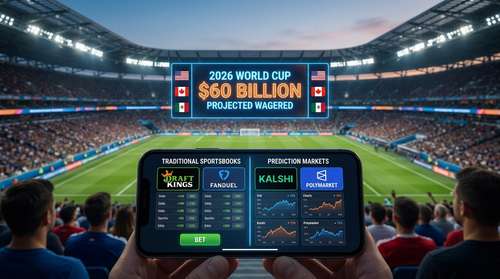
As the expanded 48-team tournament kicks off across North America this week, the sheer scale of the event is sending shockwaves through the global gambling industry. With the opening matches slated for June 11, analysts have updated their sports betting projections 2026, forecasting a monumental $60 billion in legal wagers worldwide. At least $3 billion of that action is expected to originate from the United States alone. Finding the best 2026 World Cup betting odds has never been more complicated—or more lucrative—as a fierce, high-stakes turf war erupts between traditional sportsbooks and a nimble new generation of prediction markets.
The Rise of World Cup Prediction Markets
For decades, legacy oddsmakers enjoyed a monopoly on major international soccer tournaments. That dominance is rapidly fracturing in 2026. This week, contracts backing a Polymarket World Cup winner have already eclipsed $1.5 billion in trading volume on the decentralized platform. Rather than dealing with traditional vigs and moneylines, users are treating international soccer teams like volatile tech stocks, buying and selling shares based on real-time tournament developments.
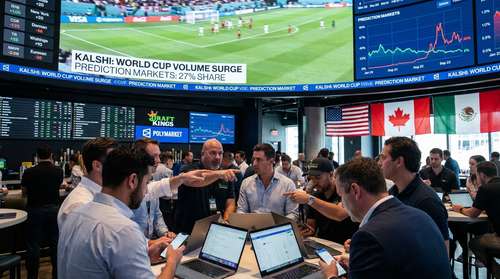
Simultaneously, federally regulated exchanges are capitalizing on their unique legal status to aggressively capture American market share. Kalshi World Cup prediction markets are pulling significant capital away from traditional gambling operators. Because platforms like Kalshi trade event contracts classified by the CFTC as financial derivatives rather than standard sports wagers, they can operate entirely legally in numerous U.S. states where traditional sports betting remains strictly prohibited. For sharp bettors and retail day-traders alike, this opens a completely new frontier for locking in value and hedging tournament futures.
Why Sharp Money is Moving
The appeal of these prediction markets lies in their structural transparency. While traditional sportsbooks bake heavy profit margins into their outright winner markets, prediction platforms are driven entirely by peer-to-peer liquidity. If the market dictates that France or Spain are co-favorites, traders buy "Yes" or "No" contracts priced between one cent and 99 cents, which settle at a dollar upon completion. This dynamic pricing model allows savvy traders to cash out positions mid-tournament, creating an entirely new financial ecosystem around the beautiful game.
Sportsbooks Counter: Microbetting and Massive Promos
Traditional operators are acutely aware of this existential threat and aren't surrendering their territory without a fight. Flutter Entertainment CEO Peter Jackson recently declared this summer's grueling 104-match marathon the "biggest betting opportunity" the industry has ever witnessed. To keep players engaged within their proprietary ecosystems, top-tier operators are rolling out unprecedented technological features tailored specifically for American audiences.
A prime example of this innovation is the massive expansion of FanDuel microbetting soccer features. The sportsbook giant is introducing specialized 120-minute markets that explicitly account for extra time, while seamlessly segmenting matches into rapid-fire microbetting intervals. Instead of simply picking a match winner or an over/under on total goals, users can now wager on the outcome of the next corner kick, throw-in, or penalty decision within seconds. This gamification of every single whistle ensures that bettors stay glued to the screen for the entire match duration.
Aggressive Customer Acquisition Tactics
The battle for user acquisition is pushing marketing budgets and promotional spending to all-time highs. Casual bettors are already seeing an absolute flood of DraftKings World Cup promos, designed specifically to lure users away from alternative markets and establish long-term brand loyalty. Recognizing the massive demographic shifts and the bilingual audience following this co-hosted North American event, DraftKings has also strategically launched a dedicated Spanish-language version of its app right before the opening ceremonies.
The Expanding Format Changes Everything
The evolution of FIFA World Cup sports betting perfectly reflects broader macroeconomic changes in how modern fans consume live sports. The jump from 32 to 48 participating nations means an extended group stage, more knockout rounds, and exponentially more broadcast hours. Every single one of the 104 matches provides a fresh data point for algorithmic traders on prediction markets, while simultaneously giving sportsbooks another distinct window to push live same-game parlays.
We are actively witnessing the complete financialization of sports entertainment. The historical divide between trading a financial asset and betting on a soccer match is officially erased. Whether you are buying shares of a heavily-favored South American squad on a derivatives exchange, or locking in a split-second live microbet on the next yellow card, the 2026 tournament will undoubtedly be remembered as the exact moment the global wagering market fundamentally and permanently transformed.