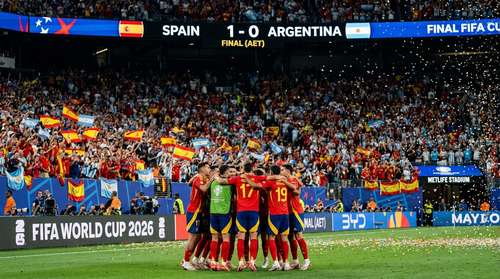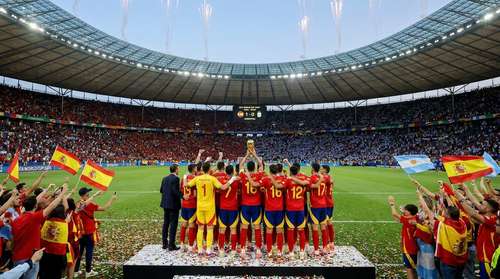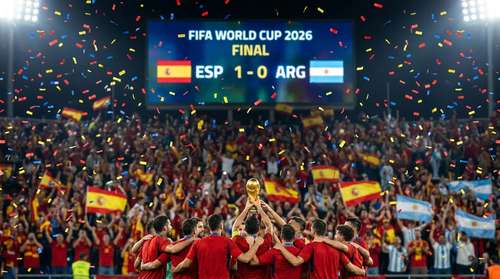
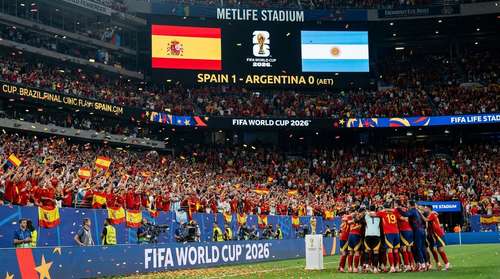
In one of the most tense and dramatic conclusions in international football history, Spain has clinched their second men's world title following a fierce Spain vs Argentina 2026 World Cup final. Playing under the bright lights of MetLife Stadium on Sunday, July 19, 2026, La Roja edged out the defending champions 1-0 in extra time. The decisive moment came via a spectacular Ferran Torres World Cup winning goal in the 106th minute, capitalizing on a numerical advantage after Argentina's Enzo Fernandez received a late red card. With this monumental victory, Spain not only secures their place as the Spain FIFA World Cup champions 2026 but achieves an unprecedented milestone in global sports.
A Grueling Battle at MetLife Stadium
The MetLife Stadium World Cup final result was born from a tactical chess match that kept an official attendance of 80,663 roaring fans on the edge of their seats. The venue in East Rutherford, New Jersey, temporarily rebadged as New York New Jersey Stadium for the tournament, provided a massive stage for the culmination of the 39-day spectacle. Right from the opening whistle, the matchup pitted Argentina's relentless attacking prowess against Spain's impenetrable defense. Coming into the final, Argentina boasted a tournament-leading 19 goals, while Spain had conceded just once.
Spanish prodigy Lamine Yamal repeatedly tested the South American defense, notably forcing a spectacular early save from Argentine goalkeeper Emiliano Martínez with a curled effort. Meanwhile, Argentina looked to strike swiftly on the counter, navigating past a Spanish gauntlet that had already dispatched heavyweights like France in the semi-finals. Tensions reached a boiling point late in regular time when Argentine midfielder Enzo Fernandez was shown a straight red card following a reckless challenge, reducing the reigning champions to ten men. This pivotal dismissal completely shifted the momentum, forcing Argentina into a deep defensive block to survive the final minutes of normal time and push the match into a grueling 30-minute extra-time period.
Ferran Torres Breaks the Deadlock
As legs grew heavy and the specter of a penalty shootout loomed, a stroke of brilliance ultimately separated the two sides. In the 106th minute, a perfectly weighted through-ball sliced through the exhausted Argentine backline. Substitute Ferran Torres latched onto the pass, took one clinical touch to compose himself, and buried the ball past the outstretched arms of Martínez. The Ferran Torres World Cup winning goal immediately etched his name into Spanish football lore, directly echoing Andrés Iniesta's iconic extra-time heroics against the Netherlands in 2010. Torres's decisive strike sent the Spanish fan zones in Madrid into pure delirium, securing the nation's second star on their crest.
End of an Era: Lionel Messi World Cup Final Defeat
For Argentina, the dramatic loss signals the bitter end of a glorious chapter. The Lionel Messi World Cup final defeat marks a poignant moment for the 39-year-old maestro, who became only the second player in history to appear in three World Cup finals, matching Cafu's legendary record from 2002. Messi had hoped to lead his nation to back-to-back world titles before riding into the international sunset.
Despite orchestrating several promising attacks and demonstrating flashes of his trademark genius, the Argentine captain found himself increasingly isolated after his team went down a man. Fans watching the 2026 World Cup final highlights will undoubtedly focus on the contrasting emotions at the final whistle: the euphoric Spanish squad piling onto each other near the corner flag, while a visibly devastated Messi was consoled by his longtime teammates. The defeat halts Argentina's modern dynasty, denying them a fourth overall championship and handing over the crown of global football royalty.
Unprecedented Glory: Spain Men and Women World Cup Holders
This triumph reverberates far beyond the men's game. Following the Spanish women's national team's spectacular 1-0 victory over England at the 2023 tournament in Sydney—secured by Olga Carmona's left-footed strike—this weekend's result makes Spain the first nation in history to simultaneously reign as the Spain men and women World Cup holders.
The historic double is a testament to the country's unparalleled youth development system and unified tactical philosophy. From Stadium Australia to MetLife Stadium, Spanish football has proven that its methodology—prioritizing technical mastery, rapid passing, and intelligent positioning—translates flawlessly across both the men's and women's squads. Being crowned the Spain FIFA World Cup champions 2026 cements the Iberian nation as the absolute epicenter of world football.
The Legacy of the 2026 Tournament
Co-hosted by the United States, Mexico, and Canada, the expanded 48-team tournament delivered weeks of unforgettable drama, culminating in a pristine Spain vs Argentina 2026 World Cup final. Sunday's match was elevated not just by the action on the pitch, but by the massive cultural spectacle surrounding it, including the tournament's first-ever halftime show curated by Chris Martin.
As global audiences replay the 2026 World Cup final highlights, the narrative of this match will remain crystal clear: a resilient, tactically superior Spanish side capitalizing on crucial moments. Spain leaves North America not just with the iconic 18-karat gold trophy, but with an immortal legacy as the undisputed dual-crown monarchs of the beautiful game.