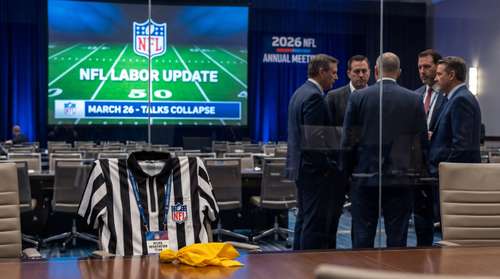
The prospect of an NFL referee lockout 2026 transitioned from a looming threat to an imminent reality this week. NFL officiating negotiations came to an abrupt halt on March 26, ending a scheduled two-day session after just a few hours. With the current collective bargaining agreement set to expire on May 31, the league and the NFL Referees Association (NFLRA) are operating at a complete impasse. The sudden breakdown has triggered an NFL officiating crisis, forcing the league to accelerate controversial contingency plans for the upcoming season.
The Breaking Point of the NFLRA Labor Dispute
Tensions between the league and its officials have been simmering since the summer of 2024, when early discussions regarding an extension first began. When both sides finally sat down this week for what was supposed to be a critical bargaining round, the NFLRA labor dispute completely fractured. NFLRA Executive Director Scott Green released a pointed statement claiming the league intentionally stalled negotiations, arguing that the NFL's lead negotiator, Larry Ferazani, arrived without authorization to move past their initial proposal. Green confirmed the union submitted a counterproposal that was flatly rejected before league representatives allegedly walked out.
The NFL views the situation entirely differently. League executives, including Executive Vice President of Communications Jeff Miller, insist the focus is firmly on modernizing the officiating program. The NFL is demanding year-round access to officials for training, greater overall accountability, and a shift toward pay-for-performance models. The league accused Green's team of refusing to adapt, claiming the union is demanding pay raises at nearly double the rate of player increases under the current CBA. Management also pointed to millions in marketing fees requested by union leadership that rank-and-file members rarely see. The union, which views these demands as extreme overreaches, has reportedly refused to engage on the league's performance improvement priorities.
The Reality of Replacement Officials NFL Fans Dread
With the May 31 deadline approaching rapidly, the league is wasting no time preparing for a season without its regular crews. The push for replacement officials NFL executives are currently organizing involves aggressively vetting roughly 150 candidates over the coming weeks. These targeted referees predominantly bring experience from small college ranks and minor professional leagues. Top-tier Division I college referees are largely avoiding the recruitment drive, unwilling to cross union picket lines and risk their future chances at permanent NFL employment.
If the lockout proceeds, these replacement crews could begin onboarding next month and attend a mandatory four-day clinic in May. For players, coaches, and fans, this strategy immediately revives memories of the disastrous 110-day lockout in 2012. That period famously culminated in the "Fail Mary" game between the Green Bay Packers and Seattle Seahawks, an officiating debacle that forced Commissioner Roger Goodell to quickly settle the labor dispute. Today's game is significantly faster and more complex, raising immediate red flags regarding player safety and the accurate enforcement of rules. Furthermore, union officials have raised dire concerns about the vulnerability of lower-level referees to gambling influences, given the massive, multi-billion-dollar expansion of legalized sports betting.
Rule Changes Proposed at the NFL Annual Meeting 2026
League owners are acutely aware of the massive risks associated with deploying amateur officials on a global stage. During the NFL Annual Meeting 2026 in Arizona, team owners began reviewing a temporary rule proposal designed specifically as a high-tech safety net. If ratified, the rule would grant the NFL's centralized officiating command center in New York the unprecedented authority to weigh in on flags thrown—or ignored—on the field.
This technological intervention aims to correct "clear and obvious" mistakes made by inexperienced replacement crews before they impact the outcome of a game. While the league's replay technology has improved exponentially over the last 14 years, allowing a remote command center to adjudicate live play from hundreds of miles away represents a monumental shift in how professional football is governed. It underscores just how deeply the league anticipates the struggles of a replacement roster navigating the chaos of an NFL Sunday.
Assessing the NFL Referee Strike Impact on the Upcoming Season
As the clock ticks down toward the end of May, the NFL referee strike impact threatens to disrupt the entire summer schedule. Without a dramatic shift at the negotiating table, replacement crews will be officiating training camp scrimmages and preseason games by August. The league remains steadfast in its desire to increase the probationary period for new officials beyond the current three-year window, while the union is fighting to lower it.
The stakes have never been higher for the most profitable league in North American sports. The NFL operates in a unique labor environment where the officials union holds significant leverage, knowing the on-field product suffers immensely in their absence. Executive Vice President of Football Operations Troy Vincent has framed this standoff as a necessary step to secure the best possible officiating for the future, but the short-term consequences could be severe. Until both sides can bridge the massive gap regarding compensation, training access, and accountability, the shadow of 2012 will continue to hang heavy over the 2026 season. Fans can only watch and wait as the standoff threatens to compromise the integrity of the game.