The push for Nebraska sports betting legalization has officially shifted from the statehouse to the voters. By mid-April 2026, the nation's "Big Four" sportsbook operators—DraftKings, FanDuel, BetMGM, and Fanatics—have collectively injected over $2.6 million into a coordinated effort to bring digital wagering to the Cornhusker State. This massive financial backing aims to bypass years of legislative gridlock by putting a constitutional amendment directly on the upcoming November ballot.
The 'Big Four' Inject $2.6 Million Into Tax Relief Nebraska
The financial muscle behind this new campaign is undeniable. According to recently released campaign finance records, FanDuel Nebraska aspirations and the DraftKings Nebraska initiative have each been funded by massive $1,162,500 contributions. These two market leaders provide the lion's share of the financial support, but they are not acting alone.
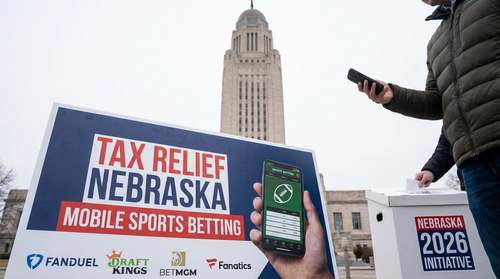
Roar Digital, a joint venture of BetMGM Nebraska, contributed $250,000, while FBG Enterprises OPCO, the parent company of Fanatics Sportsbook, added another $75,000. This collective war chest is being funneled into Tax Relief Nebraska, a dedicated ballot question committee organized to gather signatures and secure a public vote. By utilizing this localized committee, the operators hope to appeal directly to residents who want a regulated mobile wagering framework that generates state revenue.
Why Legislative Gridlock Sparked a Direct Appeal to Voters
Nebraska voters originally approved in-person sports gambling at retail casino locations back in 2020. However, any attempts to expand that framework into the digital realm have repeatedly stalled. Lawmakers spent several years debating the merits of digital platforms, but internal opposition consistently blocked progress.
The most recent disappointment for proponents occurred when Senator Eliot Bostar championed a bill to amend the state constitution. Although his legislation cleared the General Affairs Committee in 2025 and passed an initial Senate vote, it ultimately died due to a legislative filibuster. Frustrated by the state senate's inability to cross the finish line, industry leaders recognized that relying on lawmakers was no longer a viable strategy. Instead, they chose to pivot their resources toward a public referendum, ensuring that mobile sports betting 2026 remains a tangible possibility for Nebraska residents.
Keeping Revenue In-State and Defeating Offshore Markets
The core argument for the Tax Relief Nebraska ballot initiative centers on recapturing lost tax dollars. Currently, bettors in the state either drive across the border to neighboring regions like Iowa to place wagers on their phones, or they turn to unregulated offshore betting sites. GeoComply data previously presented to state committees revealed that over 4.5 million attempts to access legal online sportsbooks were blocked within Nebraska's borders.
If the Nebraska sports betting legalization initiative passes, industry experts estimate that a regulated digital market could generate upward of $32 million in total tax revenues over a 30-month period. Advocates stress that this revenue would provide much-needed property tax relief, turning an activity that is already happening in the shadows into a meaningful economic driver.
Political Contributions and Local Casino Partnerships
The financial strategy extends beyond the immediate ballot committee. Several major operators are also making targeted contributions to individual political campaigns ahead of the November election. Records show that prominent officials, including Governor Jim Pillen and Attorney General Mike Hilgers, have received substantial campaign funds from platforms and industry groups like the Coalition for Fantasy Sports, Caesars Entertainment, and WarHorse Gaming.
This localized approach is designed to foster a more receptive environment for operators if the regulatory phase begins. The ballot measures explicitly tie digital sportsbook licenses to the state's established retail casinos. Facilities in Lincoln, Omaha, Grand Island, and Columbus have already found success with retail wagering, generating millions in revenue since taking their first bets. Partnering with these properties would allow national digital operators to expand their footprint seamlessly without building entirely new localized infrastructures from scratch.
Signature Thresholds for the November 2026 Ballot
Having the necessary capital is only the first step. To guarantee that residents can vote on expanding digital access this November, the committee must meet stringent signature requirements by a July 3 deadline.
The campaign must successfully circulate two separate petitions. The first petition seeks a constitutional amendment to permit digital wagering and requires valid signatures from 10% of registered Nebraska voters. The second is a statutory petition that would establish the regulatory framework and govern how operators partner with local retail casinos, requiring signatures from 7% of the voting base. Additionally, organizers must hit a distribution requirement by collecting signatures from at least 5% of registered voters in 38 of the state's 93 counties. Backed by WarHorse Gaming and the national operators, the coalition plans to gather over 300,000 signatures to safely exceed the minimum threshold.
What Mobile Sports Betting 2026 Means for the Cornhusker State
If the signature drive is successful and voters approve the measures in November, the Nebraska Racing and Gaming Commission will take over the regulatory reins. Regulators would have until June 1, 2027, to finalize rules and officially launch the market.
The statutory framework outlines clear benefits for the state. If the initiative succeeds, the first $500,000 of the tax proceeds will directly fund the Compulsive Gamblers Fund to promote responsible gaming. After operating expenses, the remaining tax dollars will be funneled into the Nebraska Environmental Trust Fund, the State Fair Board, and crucial property tax relief programs. For sports fans, the substantial investment by industry giants proves they view Nebraska as a highly valuable frontier. As the July 3 deadline approaches, all eyes will be on whether this $2.6 million gamble finally brings mobile betting to the heartland.