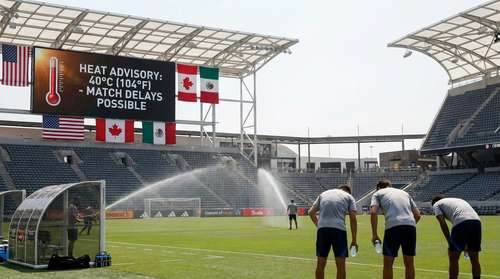
With the highly anticipated tournament less than a month away, a prominent network of climate scientists has issued an alarming report regarding FIFA World Cup 2026 heat concerns. The World Weather Attribution (WWA) group released a rapid analysis earlier this week indicating that the expanded 104-game tournament across the United States, Mexico, and Canada could face unprecedented extreme weather. According to the data, roughly one in four matches will take place in grueling heat and humidity, escalating the conversation around World Cup 2026 player safety and potential fixture disruptions.
The Science Behind 2026 World Cup Weather Risks
To understand the severity of the threat, sports scientists rely on the Wet Bulb Globe Temperature (WBGT). Unlike standard air temperature, WBGT factors in humidity, wind speed, sun angle, and cloud cover to measure how effectively the human body can cool itself through sweating. When this metric climbs, the physiological strain on elite athletes becomes dangerous.
The WWA report estimates that 26 matches are likely to be played in conditions reaching at least 26°C WBGT. At this threshold, athletes struggle to maintain thermal balance during high-intensity exertion. Even more concerning, five matches are expected to breach 28°C WBGT—a level that FIFPRO, the global players' union, classifies as unsafe for competitive play. These specific 2026 World Cup weather risks have prompted an open letter from climate experts and the New Weather Institute urging immediate organizational changes.
Severe Host City Temperature Warnings
While some stadiums in Dallas, Houston, and Atlanta feature climate-controlled roofs, the danger primarily threatens open-air venues. Over a third of the high-risk games are scheduled in stadiums without air conditioning. Host city temperature warnings are currently spotlighting Miami's Hard Rock Stadium, Kansas City's Arrowhead Stadium, and Philadelphia's Lincoln Financial Field as the most vulnerable locations for extreme thermal strain.
The concern extends all the way to the tournament's climax. Professor Friederike Otto, a climate science expert at Imperial College London and WWA co-founder, highlighted that the July 19 Grand Final at New Jersey's MetLife Stadium carries a 2.7 percent risk of reaching 28°C WBGT. She emphasized that exposing the globe's biggest sporting event to a "non-insignificant risk of being played in cancellation-level heat" should serve as a massive wake-up call for organizers.
FIFA Heat Index Protocols and Safety Measures
Faced with mounting pressure following heat-related incidents at the recent Club World Cup, organizers are heavily prioritizing World Cup 2026 player safety. Instead of relying purely on reactive measures, new, proactive FIFA heat index protocols are being implemented across all 16 host cities.
Historically, FIFA permitted cooling breaks only when the WBGT hit a blistering 32°C (89.6°F). For this tournament, however, FIFA has pivoted. Referees will enforce mandatory three-minute hydration breaks midway through both the first and second halves of every single match, regardless of the local weather conditions or whether a stadium roof is closed.
In addition to standardized hydration breaks, FIFA's tiered mitigation plan includes:
- Real-time meteorological monitoring at every venue
- Air-conditioned benches for substitutes
- A fleet of climate-controlled transit buses for teams
- Expanded water distribution and heavy-duty misting systems for spectators
The Threat of FIFA 2026 Match Cancellation
Despite these technological and scheduling adaptations, the question of a FIFA 2026 match cancellation remains a flashpoint between the governing body and player representatives. FIFPRO's medical guidelines explicitly advise that matches should be delayed or postponed entirely if the WBGT exceeds 28°C. FIFA's historical threshold for suspending play, however, sits much higher at 32°C.
If a severe heatwave aligns with a prime-time afternoon kickoff in a city like Miami or Kansas City, organizers will be forced to make a difficult choice between broadcast schedules and human health. Medical professionals have clearly stated that once environmental heat stress exceeds certain limits, short hydration breaks are no longer sufficient to prevent core body temperatures from reaching dangerous levels.
Looking Ahead at a Summer World Cup North America
The logistical reality of a summer World Cup North America is that the heat cannot be entirely avoided. While professional athletes command top-tier medical attention, experts are equally worried about the millions of fans gathering at outdoor Fan Festivals and public viewings, where medical triage is less accessible.
As the opening whistle draws near, the sport's governing bodies, host cities, and national agencies are working overtime to prepare for an unforgiving climate. Whether the extensive cooling networks and modified hydration rules will be enough to counter the scorching North American summer remains to be seen, but one thing is certain: Mother Nature is poised to be the most formidable opponent on the pitch this tournament.