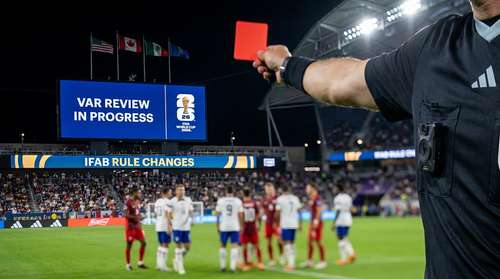
The countdown to North America's massive soccer festival has officially begun. As the 48-nation tournament prepares to kick off on June 11 across the United States, Mexico, and Canada, fans and teams alike are scrambling to understand the latest FIFA World Cup 2026 rule changes. Following the International Football Association Board (IFAB) 140th Annual General Meeting in Hensol, Wales, lawmakers have confirmed a slate of dramatic updates.
These sweeping IFAB soccer rule changes 2026 range from an aggressive crackdown on time-wasting to highly advanced broadcast technologies that will forever alter how the sport is consumed. For those following the essential 2026 FIFA World Cup news, the introduction of unprecedented technical aids and strict disciplinary measures takes center stage.
Upgraded World Cup 2026 VAR Rules
The Video Assistant Referee system has sparked constant debate since its global tournament debut in 2018. However, lawmakers have decided to hand the system even more authority to ensure match fairness. Under the expanded World Cup 2026 VAR rules, officials in the booth can now intervene in three distinct new scenarios.
First, VAR can review and overturn "clearly incorrect" second yellow cards that lead to a dismissal. Previously, only straight red cards were subject to video review. Second, the system will officially assist in cases of mistaken identity for both yellow and red cards. Finally, and perhaps most controversially, VAR can now intervene when corner kicks or free kicks are awarded in error—specifically looking for clear attacking fouls or offenses committed just before the ball is in play. Checks on set-pieces are limited to correcting obvious errors that directly impact a goal or penalty, ensuring play is not needlessly delayed.
The Landmark World Cup Mouth Covering Red Card
Football lawmakers are taking a zero-tolerance approach to on-field discrimination and abuse. One of the most striking new regulations is the World Cup mouth covering red card. Moving forward, any player who covers their mouth with a hand, arm, or jersey during a confrontational exchange will receive an immediate sending-off.
This specific rule stems from high-profile incidents in recent European competitions, notably an altercation where Benfica's Gianluca Prestianni was accused of directing slurs at Real Madrid's Vinicius Jr. while attempting to hide his lips. While friendly banter with club teammates remains completely unpunished, aggressively masking speech to hurl insults is now an automatic dismissal.
Strict Anti-Time-Wasting and Walk-Off Protests
Leading the charge for updated Pierluigi Collina World Cup officiating standards is the urgent need to keep the ball in play. The Chairman of the FIFA Referees Committee has championed rigid countdowns to drastically reduce dead match time, declaring that FIFA wants to "clean the game as much as possible".
The new regulations introduce harsh penalties for slowing the match tempo:
- Substitutions: Departing players now have a strict 10-second limit to leave the pitch. Failure to meet the cutoff forces their team to wait an additional minute after the restart before the replacement can enter.
- Restarts: Goalkeepers and throw-in takers face a harsh five-second countdown. A delayed goal kick will result in a corner for the opposition, while a delayed throw-in will surrender possession.
- Injuries: Outfield players who receive medical treatment on the pitch must remain on the sidelines for exactly one minute after play restarts. Furthermore, players are strictly prohibited from receiving tactical instructions from coaches while a goalkeeper is being treated, closing the popular "tactical timeout" loophole.
Additionally, following the chaotic scenes of recent international tournaments, IFAB has introduced a stringent rule regarding team protests. Any player or coach who abandons the pitch in protest of a refereeing decision will be shown a straight red card, with abandoning teams facing an automatic match forfeit.
Unprecedented Access: Referee View Body Camera World Cup
While players face strict new boundaries, fans are getting closer to the action than ever before. Building on a successful trial at the 2025 FIFA Club World Cup, the Referee View body camera World Cup integration is officially permitted in the Laws of the Game.
Powered by advanced AI stabilization software through a partnership with Lenovo, referees will wear specialized micro-cameras mounted near their eyeline. This first-person footage will be broadcast directly to stadium screens and global television feeds in near real-time, completely transforming the viewer experience. Audiences will literally see exactly what the referee sees during high-intensity moments, bringing massive transparency to officiating decisions. Coupled with AI-enabled 3D player avatars for semi-automated offside calls, the technological leap is staggering.
A New Era of Global Soccer
These historic adjustments guarantee that this North American tournament will be the fastest and most technologically advanced sporting event in history. From instant dismissals for offensive conduct to AI-powered broadcast views, the beautiful game is evolving. As the opening match approaches, the 170 appointed officials are undergoing final preparations, and the 48 competing nations must adapt immediately or risk falling victim to the strictest officiating standards the sport has ever seen.