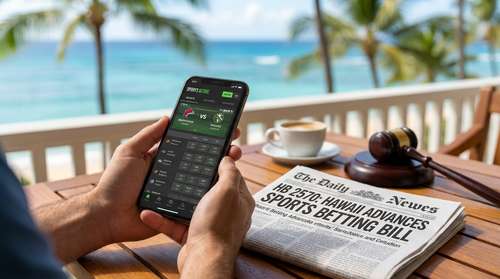
In a watershed moment for the Aloha State, the Hawaii House Committee on Economic Development & Technology has voted to advance House Bill 2570, a measure that would legalize and regulate online sports betting. This vote marks a significant shift for Hawaii, which, alongside Utah, stands as one of only two U.S. states with a complete ban on all forms of gambling. The bill passed with a 5-2 vote on February 11, 2026, moving the Hawaii sports betting bill one step closer to reality, though the road to final approval remains steep.
Breaking Down HB 2570: A New Era for Hawaii Gambling?
The advancement of HB 2570 is more than just a procedural victory; it represents a fundamental re-evaluation of Hawaii gambling legislation 2026. For decades, lawmakers have killed similar proposals before they could gain traction. This time, the need for new revenue streams and the reality of the thriving illicit market seem to be swaying opinions.
Under the proposed framework, the state would authorize at least six mobile sportsbooks in Hawaii. These operators would be completely online, preserving Hawaii's landscape from physical casinos or betting parlors. The financial barrier to entry is set high: operators would face a steep $500,000 licensing fee, renewable every five years. Furthermore, the bill proposes a 15% tax on adjusted gross revenue, a rate designed to generate substantial funds for the state.
Where Will the Money Go?
Proponents have structured the bill to address the very concerns that usually kill gambling legislation. A significant portion of the Hawaii sports betting tax revenue is earmarked for a new Problem Gambling Prevention and Treatment Special Fund, administered by the Department of Health. Additional funds would support law enforcement efforts to crack down on illegal game rooms and unregulated offshore sites that currently operate with impunity.
A Contentious Vote: "Yes" with Reservations
While the committee vote was 5-2, it wasn't a ringing endorsement from all sides. Representative Daniel Holt, a longtime champion of legalizing online sports betting in Hawaii, voted in favor but expressed frustration with the process. In a candid moment during the hearing, Holt noted that despite his history of support, he was not consulted on this specific draft.
"I appreciate you moving this forward, and all the work you have done, but it was not my idea and I was not consulted, and I just want to put that out there," Holt told his colleagues. His "yes with reservations" vote highlights the complex political maneuvering occurring behind the scenes. The bill is still seen as a "moving target," with amendments likely as it faces further scrutiny from other House committees.
Strong Opposition: Protecting the "Aloha Spirit"
The push to remove Hawaii from the list of US states with no legal gambling faces formidable opposition. During the hearing, testimony was heavily skewed against the measure, with over 40 individuals and organizations voicing dissent compared to just 11 in support. Critics argue that legalizing sports betting would fundamentally alter Hawaii's culture and social fabric.
Honolulu Prosecutor Steve Alm delivered some of the sharpest critiques, warning that the state risks profiting from addiction. "Sports betting is already tarnishing sports," Alm testified, pointing to recent scandals in major U.S. leagues. He argued that the social costs—ranging from family financial ruin to increased crime—would outweigh any tax revenue benefits. For many opponents, maintaining the "Aloha Spirit" means keeping the state free from the predatory mechanics of the gambling industry.
The Reality of the Black Market
Despite the moral arguments, the economic reality is that thousands of residents are already betting. Industry estimates suggest that Hawaii residents wager hundreds of millions of dollars annually through illegal offshore sites and local bookies. These unregulated markets offer zero consumer protection and contribute zero dollars to state coffers.
"The question isn't whether we should have sports betting in Hawaii; it's whether we should regulate the betting that is already happening," argued supporters from the Sports Betting Alliance. By bringing this activity into the light with regulated mobile sportsbooks in Hawaii, the state could implement safeguards like identity verification, deposit limits, and self-exclusion lists—tools that illegal bookies simply do not offer.
What's Next for HB 2570?
Passing the first committee is a historic first step, but HB 2570 has a marathon ahead. It must now survive additional House committees, a full House floor vote, and then repeat the entire process in the Senate. Complicating matters is a simultaneous legislative push to ban "prediction markets," which some lawmakers view as a loophole for gambling. This indicates a legislature that is still deeply wary of expanding betting in any form.
For now, the conversation has officially changed. The tabling of HB 2570 proves that even in one of the strictest anti-gambling jurisdictions in America, the pressure to modernize laws and capture lost revenue is becoming impossible to ignore. Whether this momentum can survive the rest of the 2026 legislative session remains the ultimate wager.