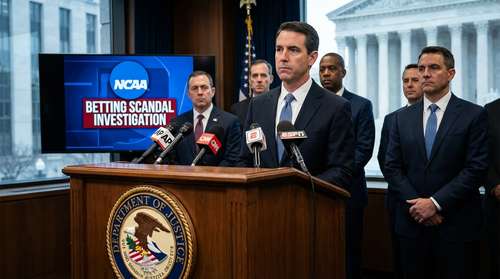
A massive federal sports betting investigation has rocked the world of college basketball, leading to charges against 26 individuals in a widespread point-shaving scheme. Federal prosecutors in the Eastern District of Pennsylvania unsealed the indictment on Thursday, revealing a conspiracy that allegedly compromised the integrity of at least 29 games across nearly two dozen NCAA programs. The investigation, which officials say "enveloped the world of college basketball," details how players were bribed between $10,000 and $30,000 to deliberately underperform, ensuring their teams failed to cover betting point spreads.
Camian Shell and the North Carolina A&T Allegations
At the center of the indictment are specific allegations against Camian Shell, a former North Carolina A&T guard currently playing for Delaware State. Prosecutors accuse Shell of conspiring with fixers to manipulate the outcome of a February 29, 2024, game against Towson University. According to court documents, Shell communicated via encrypted messages with Jalen Smith, a trainer and alleged middleman, agreeing to ensure the Aggies lost by a specific margin.
The indictment details a text exchange where Smith instructed Shell to ensure a loss of "10 or more points," assuring him that "we shouldn't need [to be] sweating." North Carolina A&T ultimately lost the game 84-58, covering the spread for the bettors. The scheme allegedly involved payments delivered to Shell in Greensboro shortly after the game. Shell is one of four active college players charged, alongside Kennesaw State's Simeon Cottle, Eastern Michigan's Carlos Hart, and Texas Southern's Oumar Koureissi.
Inside the $30,000 Bribes and "Prop Bet" Mechanics
The federal probe exposes a sophisticated operation that exploited the financial vulnerabilities of student-athletes. Prosecutors allege that the ringleaders, identified as Shane Hennen and Marves Fairley, specifically targeted players from lower-profile programs where Name, Image, and Likeness (NIL) opportunities were scarce. By offering cash bribes ranging from $10,000 to $30,000 per game, the fixers could induce athletes to shave points—purposely missing shots, committing turnovers, or playing lax defense to manipulate the final score.
Expanding Beyond Point Spreads
While traditional point-shaving was the primary method, the investigation also highlights the growing danger of prop bets—wagers on individual player statistics. The indictment suggests that the conspiracy allowed fixers to place highly specific bets on player performance, a market that is harder for regulators to monitor than final game scores. U.S. Attorney David Metcalf emphasized the scale of the operation, noting that the fixers placed millions of dollars in illicit wagers, defrauding sportsbooks and the betting public alike.
A Widening Web: From the CBA to the NCAA
The roots of the scandal reportedly stretch beyond the United States. Investigators trace the scheme's origins to the Chinese Basketball Association (CBA) in 2022, where the fixers allegedly first successfully manipulated games before turning their attention to the U.S. collegiate system. The transition to NCAA basketball represents a significant escalation, with the probe implicating at least 39 players from over 17 universities, including Tulane, DePaul, and New Orleans.
Former NBA player Antonio Blakeney was named in the investigation as a recruiter who allegedly helped bridge the gap between the professional betting ring and collegiate athletes. Although Blakeney faces charges in a separate jurisdiction, his involvement underscores the transnational nature of the conspiracy. The indictment marks one of the most significant enforcement actions since the repeal of PASPA in 2018 opened the floodgates for legal sports betting across America.
Official Fallout and the Fight for Integrity
The revelations have triggered immediate responses from sports governing bodies. NCAA President Charlie Baker released a statement affirming that the association is working closely with law enforcement and has already launched investigations into roughly 40 athletes linked to the probe. "Protecting competition integrity is of the utmost importance," Baker stated, warning that any player found involved faces a permanent ban from collegiate athletics.
For the sports betting industry, this scandal serves as a wake-up call regarding the vulnerabilities of collegiate markets. As federal courts prepare to hear the cases, the focus now turns to how universities and regulators can better shield student-athletes from the predatory tactics of professional gambling rings.