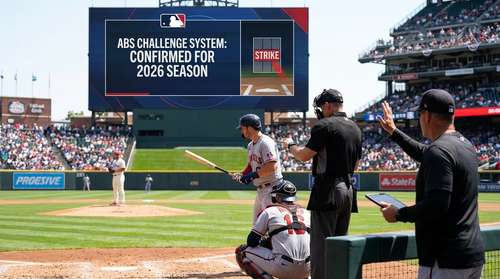
In a landmark decision that fundamentally alters America's pastime, Major League Baseball (MLB) officially confirmed on Thursday that the Automated Ball-Strike (ABS) system will be implemented for the 2026 regular season. The announcement, made as pitchers and catchers report to Spring Training, cements the introduction of a high-stakes "challenge" format rather than a fully automated zone. Under the finalized protocols, human umpires will remain behind the plate, but teams will now wield the power to challenge ball-and-strike calls in real-time using Hawk-Eye tracking technology.
The Challenge System: How It Works
Commissioner Rob Manfred's office released the definitive guidelines for the ABS Challenge System, putting an end to months of speculation regarding the specific format. Unlike a fully robotic zone that relays every call to an earpiece, the 2026 season will feature a hybrid approach designed to preserve the human element while correcting egregious errors. Each team will be allotted two challenges per game. If a challenge is successful—meaning the human umpire's call is overturned by the tracking system—the team retains that challenge.
The mechanics of a challenge are designed for speed and drama. Only the pitcher, catcher, or batter can initiate a review, and they must do so immediately following the pitch by tapping their cap or helmet. The decision is then rendered in seconds, with the pitch trajectory and strike zone displayed on the stadium's videoboard for fans to see. "This system strikes the right balance," Manfred stated in the official release. "It empowers players to correct missed calls in high-leverage moments without stripping the game of its traditional rhythm and the essential skill of receiving and framing pitches."
Technology and the Define Strike Zone
The backbone of this new era is the Hawk-Eye optical tracking system, powered by a dedicated 5G network to ensure zero latency. The official strike zone for 2026 has been standardized as a two-dimensional rectangle over the center of home plate. Crucially, the vertical limits are now dynamic: the top of the zone is set at 53.5% of the batter's height, while the bottom sits at 27%. This precision aims to eliminate the inconsistency of individual umpire zones that has frustrated players for decades.
Player and Manager Reactions
Reaction from around the league as camps opened this week has been cautiously optimistic, signaling a shift in sentiment after years of minor league testing. The Major League Baseball Players Association (MLBPA) had previously voiced a strong preference for the challenge system over a fully automated "robo-ump," valuing the strategic element it introduces. "It adds a whole new layer of strategy," said Yankees manager Aaron Boone, who has been a vocal proponent of officiating improvements. "You have to be judicious. You can't burn a challenge in the third inning on a borderline pitch and then be left helpless in the ninth."
Veteran catchers, whose careers have often depended on the art of pitch framing, are breathing a sigh of relief that the human element isn't vanishing entirely. "It keeps us in the game," noted Phillies catcher J.T. Realmuto. "If it was fully automated, framing is dead. With the challenge system, if I can steal a strike and the batter doesn't challenge it, that's still a skill. It keeps the cat-and-mouse game alive."
Impact on the 2026 Season
The introduction of the ABS Challenge System is expected to have immediate ripple effects on game outcomes and pace of play. Data from Triple-A testing in 2024 and 2025 showed that successful challenges were rare but pivotal, often flipping counts in key at-bats. The fear of endless delays appears unfounded; MLB officials confirmed that the average challenge takes approximately 15 to 17 seconds—scarcely longer than a batter stepping out of the box to adjust his gloves.
Offensively, hitters with keen eyes are expected to benefit most. The ability to challenge a "pitcher's strike" explicitly off the plate forces pitchers to attack the zone more aggressively. Conversely, pitchers can now challenge a squeezed call on the black, potentially expanding the effective zone in critical two-strike counts. As the first Spring Training games under these official rules approach this weekend, the entire baseball world will be watching to see how teams adapt to the most significant rule change since the pitch clock.
With the rules now set in stone for Opening Day 2026, the era of the unquestionable umpire is officially over. The "human element" remains, but for the first time in Major League history, it will be held accountable by the unblinking eye of technology.