The college football landscape has entered unprecedented territory. In a legal decision that essentially upends the sport's foundational rulebook, Texas Tech quarterback Brendan Sorsby has won a temporary court injunction overriding a permanent NCAA gambling ban. The stunning legal victory paves the way for the transfer quarterback to take the field for the 2026 season, despite his on-the-record admission to placing over 9,000 impermissible sports bets, including wagers on his own team. This landmark ruling has thrown conference scheduling into utter chaos, ignited a firestorm of outrage from opposing programs, and fundamentally challenged the NCAA's authority to enforce competitive integrity.
Inside the Brendan Sorsby Court Injunction
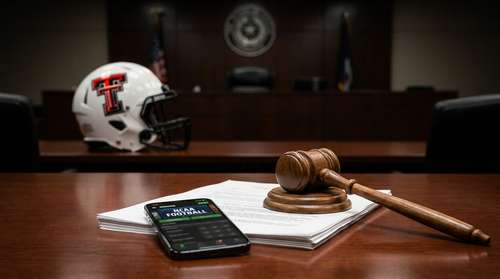
On Monday, retired Tarrant County Judge Ken Curry, sitting in the 99th District Court in Lubbock, granted the highly controversial Brendan Sorsby court injunction against the NCAA. The ruling immediately blocks the governing body from enforcing its lifetime ban on the senior signal-caller. Sorsby's legal team successfully argued that the quarterback would suffer probable, imminent, and irreparable injury if he were kept off the gridiron while his overarching lawsuit against the NCAA proceeds.
As part of the binding court order, Sorsby will serve a self-imposed two-game suspension. He will sit out Texas Tech's opening non-conference matchups against Abilene Christian and Oregon State, making him officially eligible to return for the Red Raiders' pivotal Big 12 opener against Houston on September 18. Furthermore, the court mandated that Sorsby must continue in-patient clinical counseling for his diagnosed gambling addiction, participate actively in recovery programs, and submit regular compliance reports to maintain his playing eligibility.
The Scope of the Sports Betting Addiction Case
The sheer volume of Sorsby's wagering history makes this sports betting addiction case a lightning rod for industry controversy. Court filings and NCAA investigations revealed that Sorsby placed more than 9,000 sports wagers totaling over $90,000 throughout his collegiate career. Most egregiously in the eyes of the NCAA and rival athletic directors, he placed at least 40 bets on Indiana Hoosiers football games during his time as a freshman backup quarterback for the program.
Following stints at Indiana and Cincinnati, the prolific Texas Tech quarterback transferred to Lubbock this offseason in a reported multimillion-dollar NIL deal. His admission into a residential rehabilitation facility for a clinically diagnosed gambling addiction served as the core foundation of his legal defense. The legal team argued that permanently banning a student-athlete actively seeking treatment for a recognized disease fails to prioritize athlete welfare, transforming what the NCAA views as a capital athletic offense into an employment and health rights issue.
NCAA Integrity Lawsuit Triggers Nationwide Backlash
The reaction from the broader college football sports betting community has been nothing short of explosive. The decision essentially nullifies the NCAA's strict zero-tolerance policy regarding players betting on their own games, prompting immediate threats of a widespread scheduling boycott. Athletic departments at the University of Georgia and the University of Nebraska have already reportedly instructed their programs to halt any future scheduling with Texas Tech in protest.
NCAA President Charlie Baker swiftly condemned the ruling, stating it represents a new low in college sports that fundamentally corrupts the integrity of fair competition. Behind closed doors, the outrage is even louder. Big 12 Commissioner Brett Yormark held an emergency conference call with conference athletic directors on Tuesday to address the volatile situation. Multiple Big 12 administrators, excluding Texas Tech, are reportedly united in their frustration and are having serious conversations about boycotting games against the Red Raiders this fall. Such a move would trigger an avalanche of game forfeitures, unplayed television broadcast windows, and subsequent litigation.
The NCAA has formally announced it strongly disagrees with the local court's ruling and is widely expected to appeal the decision to a higher Texas state court to preserve the bedrock of its NCAA gambling ban.
Texas Tech Defends Its Position
Despite the nationwide fury over the ongoing NCAA integrity lawsuit, Texas Tech leadership is standing firmly behind their embattled quarterback. Head coach Joey McGuire defended Sorsby this week at the Houston Touchdown Club, likening his recovery from a gambling addiction to a player rehabbing a torn knee ligament. Addressing the widespread industry rage, McGuire bluntly noted that while none of this is OK, the offense is not murder, emphasizing that the young man needs support.
Meanwhile, Texas Tech Athletic Director Kirby Hocutt released a comprehensive statement attempting to distance the university from the litigation itself while unequivocally supporting the player's rehabilitation. Hocutt clarified that the school did not fund or file the lawsuit, emphasizing that a young man in clinical treatment simply exercised his legal right to seek a remedy in the local courts.
As the 2026 season rapidly approaches, the collision course between the Texas legal system and college athletics is firmly set. Whether Brendan Sorsby actually takes the first snap against Houston in September remains to be seen, but his temporary legal victory has already forced college football to confront the most significant threat to its competitive framework in modern history.