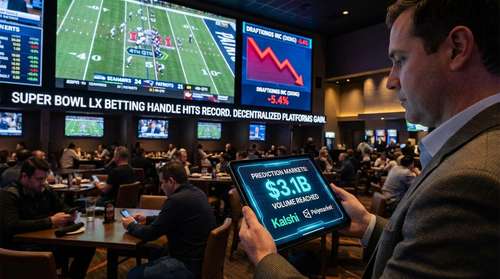
While the confetti has barely settled on the Seattle Seahawks' clash with the New England Patriots in Super Bowl LX, the real game-changer wasn't played on the turf at Levi's Stadium—it was fought on the order books of decentralized exchanges. In a watershed moment for the gambling industry, prediction markets like Kalshi and Polymarket captured a record-breaking $3.1 billion in trading volume for Sunday's championship. This seismic shift in bettor behavior triggered an immediate financial aftershock on Monday morning, with traditional sportsbook giants seeing their stocks skid as data confirmed a 2% decline in their expected betting handle.
The $3.1 Billion Pivot: Traders Ditch the "House"
For decades, the Super Bowl has been the crown jewel of the traditional sports betting calendar. However, February 8, 2026, marks the date the monopoly began to crack. Unlike the 2025 season, where sportsbooks like DraftKings and FanDuel maintained an iron grip on the market, Super Bowl LX saw a mass migration of sophisticated bettors toward event contracts.
The allure? Zero limits and no "vig." While traditional books were charging their standard -110 juice, platforms like Kalshi offered binary outcome contracts that allowed users to trade purely on probability. According to post-game data, the $3.1 billion in volume wasn't just "new money"—it was cannibalized revenue. The estimated 2% dip in traditional sportsbook handle represents hundreds of millions of dollars that bypassed the sportsbooks' profit margins entirely.
Wall Street Reacts: DraftKings and Flutter Stumble
The market reaction was swift and brutal. As trading opened on February 9, shares of DraftKings (DKNG) and FanDuel's parent company, Flutter Entertainment (FLUT), tumbled in early trading. Analysts are calling it a "wake-up call" for the industry.
"The narrative has always been that prediction markets are a niche product for political junkies," noted a senior analyst at Gaming Compliance International. "Yesterday proved that theory dead. When you have billions flowing into a Seahawks win probability contract instead of a moneyline bet, you're looking at a fundamental disruption of the sportsbook business model."
The "Bad Bunny" Effect
It wasn't just the game outcome driving volume. Prop trading on the halftime show featuring Bad Bunny saw explosive activity on decentralized platforms. Polymarket, which operates on a decentralized infrastructure, reportedly handled over $700 million in exotic props alone—ranging from the first song setlist to the color of the Gatorade bath—markets that regulated sportsbooks often face strict limits on offering.
Kalshi vs. Polymarket: The Battle for Liquidity
Two titans emerged as the primary beneficiaries of the Super Bowl LX boom:
- Kalshi: Leveraging its CFTC-regulated status, Kalshi attracted institutional capital and high-net-worth traders looking for a compliant way to hedge massive positions. Their "Yes/No" contracts on the Seahawks' victory became the most liquid single-event market in the platform's history.
- Polymarket: dominating the offshore and crypto-native demographic, Polymarket's volume surged thanks to its seamless USDC integration and lack of friction for international traders.
"We are seeing the democratization of odds-making," said a spokesperson for a major decentralized finance (DeFi) advocacy group. "In 2026, bettors realized they don't need a middleman taking a 10% cut just to place a wager."
Legal Gray Zones and Future Outlook
Despite the record numbers, the regulatory landscape remains a minefield. While Kalshi operates under federal oversight, the surge in decentralized volume has state regulators scrambling. Several state gaming commissions have already hinted at emergency sessions this week to address the "unlicensed leakage" of tax revenue to decentralized platforms.
However, the genie appears to be out of the bottle. With the 2026 FIFA World Cup on the horizon later this year, the Super Bowl LX disruption serves as a proof-of-concept. If prediction markets can capture $3.1 billion for a single NFL game, the traditional sportsbook model may face an existential threat sooner than anyone predicted.