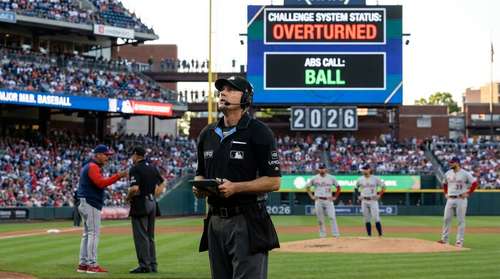
The era of the infallible umpire is officially over. When Major League Baseball rolled out the long-awaited MLB ABS challenge system for the 2026 season, fans and players knew it would alter the fabric of the sport. But few predicted just how swiftly and dramatically the new technology would expose the human element behind the plate. During the opening weekend, the system didn't just tweak the margins of the strike zone—it flipped the script entirely, turning the spotlight onto veteran officials and validating years of player frustration.
How the Automatic Balls and Strikes Technology Works
Before looking at the weekend's chaos, you need to understand the mechanics of these MLB opening day rule changes. Unlike a fully automated strike zone where every pitch is called by a computer, baseball opted for a hybrid approach. The human umpire still makes the initial call. However, the batter, pitcher, or catcher can immediately contest the decision by tapping their helmet or head.
Each team starts the game with two challenges. If the Hawk-Eye tracking technology proves them right, they retain the challenge for future use. If they are wrong, they lose it. The entire review takes just seconds, flashing the digital strike zone on the stadium scoreboard for the world to see. It is swift, public, and merciless.
CB Bucknor Overturned Calls Highlight Cincinnati Drama
Nowhere was the brutal efficiency of the new system more evident than at Great American Ball Park on Saturday, March 28. The Cincinnati Reds hosted the Boston Red Sox in what became a masterclass on why robot umps 2026 became a reality. Veteran umpire CB Bucknor found himself directly in the crosshairs of the new technology.
During the 6-5 extra-inning victory for the Reds, players challenged eight of Bucknor's calls. An astonishing six of those calls were reversed. That represents a massive 75 percent failure rate on contested pitches for the veteran official.
The most defining sequence arrived in the bottom of the sixth inning. With the bases loaded, Boston rookie reliever Ryan Watson threw back-to-back pitches that Bucknor emphatically punched out as strikes against Reds slugger Eugenio Suárez. Suárez immediately tapped his helmet after both calls. The scoreboard revealed the pitches missed the zone, overturning the outs and keeping a crucial rally alive while the Cincinnati crowd erupted.
A Shift in Momentum and Managerial Frustration
The sheer volume of CB Bucknor overturned calls fundamentally shifted the momentum of the game. Later in the eighth inning, the tension boiled over when Red Sox manager Alex Cora was ejected after arguing a controversial check-swing strikeout against Trevor Story.
"He has one job to do, it's call balls and strikes," Cora remarked postgame. "It wasn't his best day. That's what the system does. It's out there. Everybody sees it."
On Thursday's Opening Day matchup, Red Sox prospect Roman Anthony provided a textbook example of how to leverage the technology. Facing a 3-2 count with two outs in the ninth inning, Anthony was rung up on a low pitch that missed by 2.7 inches. Without hesitation, he tapped his helmet. The call was reversed to a ball, Anthony took his walk, and Boston subsequently scored two insurance runs in their 3-0 victory.
Early MLB Challenge System Stats Reveal Immediate Impact
If you think Bucknor's afternoon was an isolated incident, the broader numbers suggest otherwise. Early MLB challenge system stats from the opening slate of games paint a fascinating picture of the current officiating landscape. Over the first four days and 35 games of the season, players initiated 124 total challenges. A staggering 67 of those—or 54 percent—resulted in overturned calls.
Catchers and pitchers are currently winning challenges at a slightly higher clip than hitters, particularly on pitches located below the strike zone. Because the human eye struggles to track breaking balls diving below the knees from a standing position behind the catcher, the cameras are frequently rescuing pitchers who execute perfect low-zone sweepers.
The Future of Baseball Officiating News
The arrival of automatic balls and strikes fundamentally rewrites the unwritten rules of the diamond. For over a century, arguing a called third strike was a fast track to an ejection. Now, it is a calculated strategic maneuver. Players no longer have to suffer in silence or rely on their manager to perform a theatrical dirt-kicking routine to prove a point.
This immediate accountability will likely force a massive adjustment period for veteran crews. The technology strips away the protection of ambiguity, putting a harsh spotlight on consistent misses. As the remainder of the schedule unfolds, making baseball officiating news for the right reasons will require umpires to adapt rapidly.
Baseball has finally dragged its strike zone into the 21st century. Judging by the chaotic brilliance and unsparing accuracy of opening weekend, the relationship between players and umpires will never be the same.