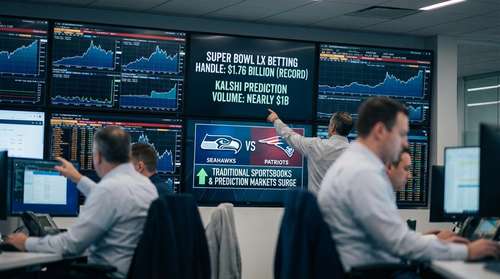
The landscape of American sports wagering fundamentally shifted this week as official reports confirmed that Super Bowl LX betting handle reached an all-time high of $1.76 billion across legal, regulated sportsbooks. Following the Seattle Seahawks' decisive 29-13 victory over the New England Patriots on February 8, 2026, data reveals a historic surge in activity not just at traditional counters, but within the booming sector of decentralized finance. For the first time, prediction markets NFL volumes posed a legitimate challenge to the status quo, with platforms like Kalshi processing nearly $1 billion in event contracts, signaling a new era for sports betting records 2026.
Traditional Books Post Monster Numbers Despite Competition
According to the American Gaming Association (AGA), the $1.76 billion wagered at state-regulated sportsbooks represents a significant year-over-year increase, defying early concerns that market saturation had been reached. The volume was driven by the massive public interest in the "Legacy Rematch" between Seattle and New England. However, the growth story is no longer solely about DraftKings or FanDuel. The Super Bowl LX betting handle tells a broader tale of a diversified gambling economy where bettors are increasingly sophisticated, splitting their bankrolls between traditional lines and binary event contracts.
While the headline number is staggering, it only accounts for state-licensed operators. When combining the regulated handle with the exploding volume from federally regulated prediction markets, the total liquidity on the Big Game likely exceeded $3 billion. This fragmentation suggests that while traditional books are still growing, they are losing market share percentage-wise to alternative exchanges that offer different pricing models and higher limits for retail traders.
Kalshi Super Bowl Volume Signals a Paradigm Shift
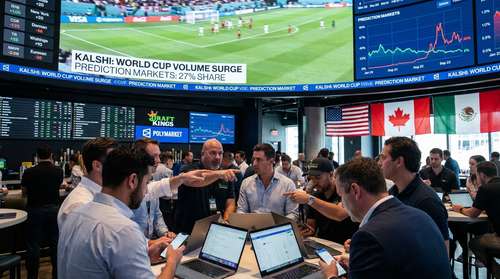
The most disrupting narrative of the weekend was the unprecedented activity on Kalshi. The federally regulated exchange reported Kalshi Super Bowl volume of over $850 million across its suite of Big Game markets, with approximately $500 million traded on the game winner alone. Unlike traditional sportsbooks that charge a vigorous "vig" (juice), prediction markets allow users to trade shares of outcomes between 1 and 99 cents, creating a peer-to-peer structure that attracted a new wave of mathematically inclined bettors.
Prediction Markets vs. Traditional Odds
The efficiency of these markets was on full display. While sportsbooks held the Seahawks as 4.5-point favorites with standard -110 odds, prediction markets offered a fluid, real-time probability that adjusted instantly to every play. The ability to trade in and out of positions during the game—scalping volatility as Seattle's defense clamped down on Patriots quarterback Drake Maye—offered a level of control that traditional in-game betting interfaces struggle to match. This Super Bowl 60 gambling trends shift indicates that bettors are increasingly viewing sports wagering through the lens of financial trading rather than pure gambling.
Seahawks vs Patriots Betting Results: A Mixed Bag for Bettors
On the field, the Seahawks vs Patriots betting results delivered a classic "public win, sharp loss" scenario regarding the side, but a massive victory for books on the total. Seattle, closing as 4.5-point favorites, covered the spread comfortably in their 29-13 win. Public bettors heavily backed the Seahawks, who dominated defensively, holding New England scoreless through three quarters. However, the total, which closed around 45.5, stayed Under, salvaging the night for many sportsbooks that would have otherwise been crushed by the favorite covering.
The game script was a nightmare for Over bettors. Despite a flurry of fourth-quarter scoring, the defensive struggle in the first half—marked by Jason Myers' record-setting five field goals—kept the score low. The "Under" cashing was a critical revenue driver for operators, balancing the liability from the heavy Seahawks moneyline and spread action.
The "Walker Reversal" Saves Sportsbooks Millions
One specific moment fundamentally altered the legal sports wagering stats for the event. Late in the fourth quarter, Seahawks running back Kenneth Walker III broke loose for what appeared to be a 49-yard touchdown run. Had the score stood, it would have been catastrophic for sportsbooks on two fronts: it would have pushed the game Over the total of 45.5, and it would have cashed millions of dollars in "Anytime Touchdown Scorer" prop bets, as Walker was the most heavily bet player to score.
Instead, a holding penalty nullified the play. Walker finished with a spectacular 135 rushing yards but zero touchdowns. This single penalty likely swung the industry's net revenue by over $100 million, turning what could have been a break-even day for books into a profitable one. It serves as a brutal reminder of the variance inherent in prop betting, where a single yellow flag can erase a winning ticket.
Future of NFL Wagering
As the dust settles on Super Bowl LX, the industry faces a new reality. The 2026 season proved that prediction markets are not a fad but a formidable competitor to the traditional sportsbook model. With prediction markets NFL activity doubling year-over-year, state regulators and traditional operators will need to adapt. For the bettor, the future is bright: more options, tighter pricing, and the ability to treat Sunday's action like Monday's stock market.