
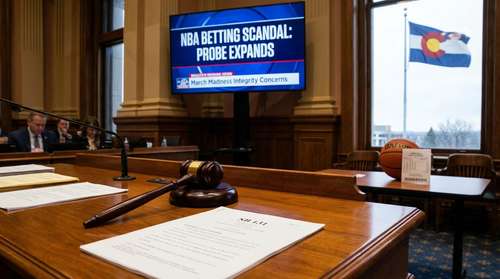
DENVER – Colorado’s legislative landscape was thrown into high gear this weekend as Senate Bill 131, a sweeping bipartisan measure to overhaul the state's sports betting laws, surged to the forefront of the Senate Finance Committee’s agenda. The bill’s sudden urgency follows a cascade of federal indictments involving NBA players and NCAA athletes, creating a perfect storm of political pressure just days before the start of March Madness. With the industry reeling from the NBA betting scandal 2026, lawmakers are rushing to pass what could be the strictest sports betting regulations in the country.
SB 131: A "Guardrail" for a Runaway Industry
Introduced formally on February 25 and gaining critical traction over the last 48 hours, Colorado SB 131 proposes a total ban on player proposition bets—wagers on individual athlete performances rather than game outcomes. The bill, sponsored by Senators Matt Ball (D) and Byron Pelton (R), frames the issue as a public health emergency. Beyond the prop bet ban, the legislation seeks to prohibit the use of credit cards for funding betting accounts, limit users to five deposits within a 24-hour period, and ban push notifications soliciting wagers.
“Coloradans made it clear in 2019 that they wanted a legal sports betting market, but things have gotten out of hand,” Senator Ball stated in a press briefing following the bill’s introduction. “It’s become clear that we need guardrails on the industry to protect the integrity of sports and the mental health of our youth.” The senator’s comments come as Colorado gambling laws face their most significant stress test since legalization.
The "Ticking Clock" of March Madness
The push for sports betting integrity has taken on a fevered pitch as regulators look toward the NCAA tournament. With March Madness betting news dominating headlines, state officials are desperate to avoid a repeat of the scandals that have plagued the 2025-2026 season. The federal probe, which recently charged 26 individuals—including 15 college players—in a massive point-shaving scheme, has exposed how vulnerable student-athletes are to the pressures of prop betting. Lawmakers argue that eliminating these specific wagers removes the primary vehicle for game manipulation.
Fallout from the Federal Gambling Probe
The legislative crackdown in Colorado is a direct response to the massive federal gambling probe that has rocked professional sports. The investigation, spearheaded by the U.S. Attorney’s Office for the Eastern District of New York, recently led to the arrests of high-profile figures, including Miami Heat guard Terry Rozier and Portland Trail Blazers coach Chauncey Billups. The scandal, which involves allegations of insider trading on injury reports and point-shaving, has shattered the illusion that major leagues are immune to corruption.
NBA Commissioner Adam Silver, who admitted to being “deeply disturbed” by the revelations, has found the league’s integrity protocols under fire. The indictments revealed a sophisticated network where non-public information was used to defraud sportsbooks, with player prop bet ban advocates citing these exact scenarios as proof that the current system is broken. Colorado’s move could set a precedent for other states like Ohio and Maryland, which have already restricted college props, to expand those bans to the professional level.
Industry Pushback and Economic Reality
As the bill moves to the Senate Finance Committee, the sports betting industry is mounting a fierce defense. The Sports Betting Alliance and major operators argue that SB 131 would inadvertently fuel the black market. By removing popular betting options like player props—which account for a significant portion of handle—they claim bettors will simply flock to unregulated offshore sites that offer no consumer protections.
“This proposal undermines the very consumer protections it claims to advance,” warned a spokesperson for the industry over the weekend. Critics also point out that the associated drop in tax revenue could impact the Colorado Water Plan, which is funded by sports betting proceeds. However, sponsors of the bill remain undeterred, citing the skyrocketing rates of gambling addiction among young men as a cost far greater than any lost tax revenue.
What’s Next for Colorado Bettors?
For now, the situation remains fluid. If passed, the ban on credit card deposits and prop bets would fundamentally alter the user experience for Colorado bettors. The bill also includes strict advertising curfews, banning sports betting ads between 8 AM and 10 PM and during live game broadcasts—a move that would dramatically change how fans consume sports media. As the Senate Finance Committee prepares for hearings, the eyes of the entire U.S. gambling industry are fixed on Denver, waiting to see if Colorado will become the first domino to fall in a new era of restriction.