With the global soccer stage set to open in North America this Thursday, June 11, athletes are preparing to face an opponent far more relentless than any defending champion. The looming threat of World Cup 2026 extreme heat has prompted a massive outcry from the medical and sports science communities. A broad coalition of experts has warned that the sport's current heat stress protocols are critically outdated, leaving athletes, venue workers, and millions of traveling fans vulnerable to severe medical emergencies.
The Fight for 2026 World Cup Player Safety
For months, researchers have sounded the alarm over the oppressive weather conditions awaiting players in southern host cities like Miami, Houston, and Atlanta. Leading the charge is the University of Connecticut's Korey Stringer Institute, alongside global health advocates, climatologists, and professional player unions.
In a widely circulated Korey Stringer Institute FIFA letter, scientists and medical professionals bluntly told the international soccer governing body that its existing safety standards fall drastically short of modern exercise physiology. The document respectfully but firmly urges leadership to adopt contemporary occupational health principles and prioritize proactive prevention over emergency response.
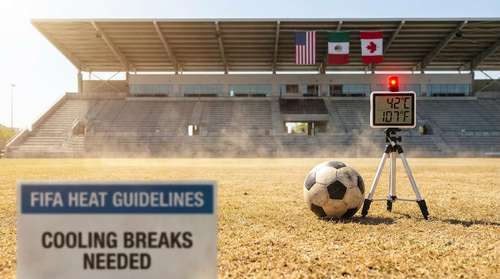
The core issue revolves around the official soccer cooling breaks rule. Currently, tournament regulations mandate a three-minute hydration pause at the 30-minute and 75-minute marks only when the Wet Bulb Globe Temperature (WBGT) reaches 32°C (89.6°F). Sports physiologists argue this threshold is dangerously high. A WBGT of 32°C—a specialized metric combining air temperature, humidity, wind speed, and solar radiation—can equate to actual air temperatures soaring near 45°C (113°F) under moderate humidity conditions.
Reforming FIFA Heat Mitigation Guidelines
To adequately guarantee 2026 World Cup player safety, the open letter's signatories—including KSI CEO Douglas Casa and Chief Research Officer Robert Huggins—have urged organizers to drastically lower the action threshold. They propose triggering mandatory cooling breaks when the WBGT hits 26°C (78.8°F).
Moreover, the experts insist these breaks must be extended from three to at least six minutes. A longer pause allows medical staff to implement active and effective cooling strategies. Three minutes barely gives athletes enough time to consume fluids, let alone apply ice towels or retreat to temporary shade structures. Since players are strictly prohibited from leaving the pitch during these intervals, the additional time is crucial for core temperature management.
Casa and other physiologists warn that pushing athletes at elite intensities beyond the 28°C WBGT mark inherently compromises physical performance. When the body reaches its thermal limit under extreme conditions, it enters a phase of 'volitional exhaustion'—a protective mechanism where the brain forces the muscles to stop working to prevent catastrophic internal damage.
Navigating Extreme Heat Soccer Matches 2026
The geography of this summer's tournament presents unprecedented logistical hurdles. While stadiums in northern host cities might offer milder climates, the southern venues are notorious for suffocating summer humidity. Sweating is the human body's primary cooling mechanism, but high ambient moisture prevents sweat efficiently evaporating. Instead of cooling down, the heat remains trapped inside the athlete.
Elite footballers routinely cover between seven and ten miles per match. The continuous sprinting, tackling, and rapid directional changes generate massive internal metabolic heat. When the ambient environment fails to absorb that heat, core temperatures can spike to levels that trigger exertional heat stroke.
The Broader Impact on Workers and Fans
While the athletes capture the broadcast headlines, extreme temperatures also threaten the massive operational apparatus surrounding the tournament. Tens of thousands of venue staff, security personnel, and construction workers face immense occupational heat stress. Recent studies analyzing three decades of meteorological data for the host cities predict frequent safety threshold breaches for outdoor workers during the June and July schedule.
Furthermore, unacclimatized tourists traveling from cooler international climates to attend afternoon kickoffs are equally at risk. Without proper venue-specific heat management plans, local emergency rooms could see surges in fans suffering from heat exhaustion.
Time is Running Out for a Rule Change
Despite public commitments to player welfare and evidence-based medical policies, the core FIFA heat mitigation guidelines have remained largely untouched since 2015. Critics of the organization point out a stark contradiction between its official medical strategy and its slow response to climate-driven environmental stress. The open letter even highlighted an inherent conflict of interest regarding the organization's active promotion of fossil fuel sponsors, tying the overarching climate crisis directly to the deteriorating conditions on the pitch.
Updating the rulebook before the opening match is not just a matter of optimizing athletic performance; it is a fundamental duty of care. Implementing a strict, scientifically backed protocol could mean the difference between a historic sporting spectacle and a highly preventable tragedy.
With the tournament just 48 hours away, all eyes are fixed on the governing body's next move. The medical consensus is abundantly clear, and the climatological data is undeniable. Now, officials must decide if they will adapt their regulations to protect the physical well-being of everyone involved in extreme heat soccer matches 2026.