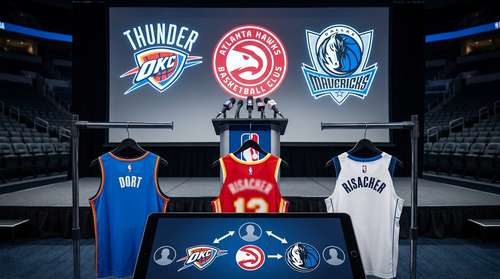
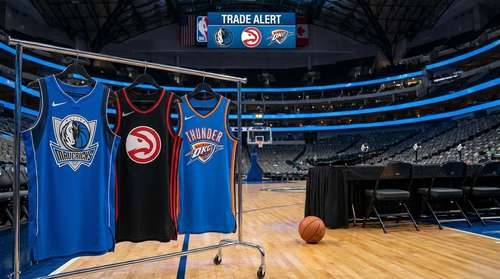
The sluggish days of mid-July are officially over. In one of the most consequential NBA offseason trades 2026 has delivered, the league landscape just experienced a seismic shift. According to ESPN’s Shams Charania, a massive Thunder Mavericks Hawks trade has been finalized. The sweeping transaction reshapes the title contention picture in both conferences and radically alters three distinct franchise timelines.
The Dallas Mavericks land former No. 1 overall pick Zaccharie Risacher, banking on his untapped upside to accelerate their new era. Meanwhile, the Lu Dort Atlanta Hawks pairing immediately establishes one of the most formidable defensive perimeter units in the league. Finally, the Oklahoma City Thunder execute a financial masterstroke, dodging restrictive luxury tax penalties while stockpiling even more draft capital.
The Trade Breakdown: Who Gets What?
Blockbuster deals of this magnitude require incredible front-office negotiations and financial gymnastics. After weeks of quiet maneuvering, all three teams found the necessary sweet spot to execute the exchange. Here is exactly how the assets are changing hands:
- Dallas Mavericks Receive: Zaccharie Risacher
- Atlanta Hawks Receive: Lu Dort, Ryan Nembhard
- Oklahoma City Thunder Receive: 2027 second-round pick (via Bulls), 2031 second-round pick (favorable of Hawks/Rockets), 2032 second-round pick (favorable of Hawks/Lakers)
Dallas Mavericks Form a Juggernaut
By executing the Zaccharie Risacher trade, the Mavericks have acquired their third former No. 1 overall pick, slotting him next to Kyrie Irving and newly minted cornerstone Cooper Flagg. Team president Masai Ujiri and general manager Mike Schmitz have aggressively reshaped this roster in recent months. To see the Hawks and Mavs trade Zaccharie Risacher highlights Dallas's unwavering commitment to prioritizing young, high-ceiling talent.
From a financial perspective, Risacher’s $13.8 million rookie contract fits cleanly into the large trade exception Dallas created when they shipped out Anthony Davis earlier in February. While Risacher struggled to find a consistent rhythm in Atlanta, a fresh start off the bench in Dallas could unlock the two-way potential that made him the top selection in 2024. With Cooper Flagg drawing massive defensive attention, Risacher will benefit from significantly better floor spacing. Ujiri and Schmitz are banking on the 21-year-old developing into a premium 3-and-D threat alongside their established stars.
Lu Dort and Ryan Nembhard Transform Atlanta's Perimeter
The Atlanta Hawks desperately needed a defensive anchor on the wing, and team president Onsi Saleh finally found his man. The Lu Dort Atlanta Hawks acquisition immediately shifts the team's entire identity. Pairing Dort alongside Dyson Daniels and Nickeil Alexander-Walker gives Atlanta arguably the most terrifying point-of-attack defensive trio in basketball.
The Ryan Nembhard trade component shouldn't be overlooked, either. The undrafted Canadian point guard fought his way into the Mavericks' rotation last season, appearing in 60 games and averaging 5.3 assists per contest. Nembhard provides crucial backcourt depth and playmaking behind Atlanta's primary ball-handlers. Even after absorbing Dort's contract, the Hawks are beautifully positioned for the future, projecting to have over $40 million in cap space next summer.
OKC Thunder Second Apron Evasion Masterclass
Why would a championship-contending team trade away a foundational defensive piece like Lu Dort? The answer lies entirely in the NBA's punishing new collective bargaining agreement. By facilitating this Thunder Mavericks Hawks trade, Oklahoma City essentially performed a masterclass in salary cap management.
The Thunder exited the playoffs roughly $40 million above the dreaded second apron. By moving Dort—and generating a $17.7 million trade exception in the process—the franchise shed an astonishing $224 million in combined salary and luxury tax obligations. This calculated maneuver comfortably pulls the OKC Thunder second apron situation back from the brink, securing their long-term flexibility.
What's Next for Oklahoma City?
It is rarely popular to trade away a starter who was instrumental in a title run, but Dort's offensive inconsistencies made him expendable in the face of steep financial penalties. His 20% three-point shooting during crucial playoff matchups against the Spurs ultimately limited his late-game workload. With sophomore Cason Wallace rapidly ascending and commanding a full-time starting role, Oklahoma City could afford to retool.
Acquiring three future second-round picks allows general manager Sam Presti to keep his asset war chest fully stocked. Combined with earlier summer moves involving Aaron Wiggins and Isaiah Joe, the Thunder have quietly gathered seven second-rounders this offseason. This massive three-team exchange proves that even in the dog days of summer, the NBA never truly sleeps. Dallas gets its upside swing, Atlanta gets its defensive identity, and Oklahoma City secures ultimate financial freedom.