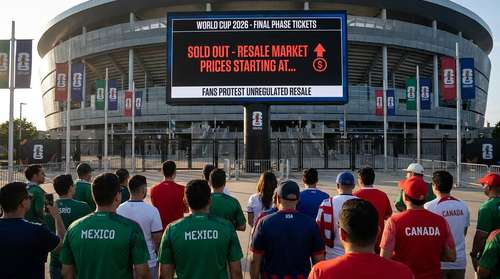
The countdown to June 11 is firmly on, but the scramble to secure a seat at the biggest sporting event on earth has become fiercely expensive. Just over a month out from the tournament, soccer's governing body has officially opened the final inventory window. While fans rush to secure World Cup 2026 last minute tickets, a massive global backlash is brewing over record-breaking costs, unprecedented dynamic pricing models, and an increasingly unregulated secondary market.
Navigating FIFA World Cup 2026 Ticket Prices in the Final Phase
The highly anticipated Last-Minute Sales Phase is now live on FIFA’s official portal, operating strictly on a first-come, first-served basis without the ballot system used in previous rounds. This critical phase unloads fresh inventory for all 104 matches across the United States, Canada, and Mexico. However, fans enduring the long digital queues are experiencing a severe case of sticker shock once admitted to the portal. The FIFA World Cup 2026 ticket prices have shattered historical benchmarks, reflecting what officials call "market rates".
While FIFA maintains that roughly a quarter of group-stage tickets cost under $300, those accessible seats are evaporating in seconds. The reality for the average traveling supporter is far more daunting. Mid-range group matches routinely demand between $400 and $1,120, while high-profile games featuring the United States, Argentina, or Brazil push well past the $2,000 mark. For instance, the USMNT’s crucial group stage opener against Paraguay in Los Angeles features standard seating options cresting above $4,100 directly from the primary source.
The Staggering Reality of MetLife Stadium Final Tickets
Nothing illustrates the current pricing controversy quite like the championship match. Just recently, FIFA quietly updated its direct ticketing site, significantly raising the cost of its premium available inventory. Prime front-row Category 1 MetLife Stadium final tickets for the July 19 climax in East Rutherford, New Jersey, were officially listed at an eye-watering $32,970.
Fan advocacy groups across Europe and the Americas have labeled the pricing structure a "monumental betrayal". They draw sharp contrasts to the 2022 tournament in Qatar, where top-tier final tickets were capped at around $1,600. FIFA President Gianni Infantino recently defended the sharp escalation at a Beverly Hills conference, arguing that the organization must adapt to the highly commercialized North American entertainment landscape. Infantino claimed that artificially lowering face value would only enrich third-party scalpers, pointing out that U.S. sports fans routinely pay premium prices for regular-season domestic events.
How the FIFA Ticket Resale Platform is Fueling the Outrage
The secondary market is where the total 2026 FIFA World Cup attendance cost truly spirals out of control. Unlike past tournaments where resale values were strictly capped at original face value, the current FIFA ticket resale platform allows sellers in the US and Canada to set their own asking prices. The results have been entirely chaotic.
Recent marketplace listings for the MetLife final have approached $2.3 million for a single seat in the lower deck. While asking prices don't necessarily equate to actual sales, the structure itself heavily incentivizes inflation. FIFA extracts a 15% fee from the buyer and another 15% from the seller on every transaction. This means the governing body essentially pockets $30 out of every $100 spent on the secondary exchange, creating massive supplementary revenue while fans shoulder the heavy financial burden of an unregulated bidding war.
Safe Purchasing Protocols: How to Buy 2026 World Cup Tickets
Despite the exorbitant costs and market frustration, you should strictly buy 2026 World Cup tickets through official channels. Purchasing off third-party broker sites or unregulated social media groups carries immense financial risk. FIFA utilizes digital tickets tied directly to an official mobile app, meaning duplicated or fake QR codes sold outside the ecosystem will not grant stadium entry. The official resale exchange remains the only guaranteed method to ensure your seat is valid, and tickets purchased elsewhere can be canceled without notice.
World Cup 2026 Opening Match Tickets and Group Stage Realities
The financial hurdles aren't limited to the knockout rounds or American venues. Demand for World Cup 2026 opening match tickets—featuring host nation Mexico taking on South Africa at the historic Estadio Azteca on June 11—has completely outstripped the available supply. With the primary allocation effectively sold out, desperate supporters are forced to monitor the official exchange, where Mexican consumer protection regulations thankfully still cap resale markups at face value.
For fans determined to participate in the historic 48-team tournament, ultimate flexibility is required. Attending lower-profile group matches in high-capacity venues offers the most realistic entry point for budget-conscious fans. Games like Curaçao against Ivory Coast are still seeing standard availability around $380. As national teams finalize their travel rosters and the June kickoff rapidly approaches, expect inventory to fluctuate wildly as fans alter their plans. The Last-Minute Sales Phase will remain open until the final whistle, but the window to secure an affordable piece of soccer history is rapidly closing.