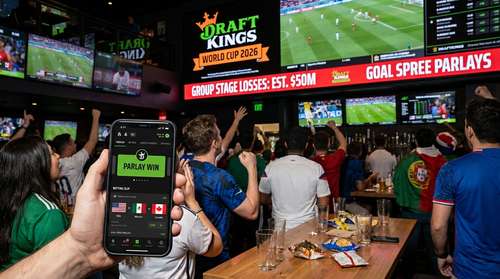
The 2026 FIFA World Cup has been a thrill ride for soccer fans, but for the sports betting industry, the opening weeks have delivered an absolute financial thrashing. High-scoring star players and fan-favorite teams have turned the tournament into a costly endeavor for traditional gambling operators. Nowhere is this more apparent than with DraftKings, where an unprecedented string of sports betting parlay payouts has left the operator reeling. According to a newly released Bank of America DraftKings report, the DraftKings World Cup losses have reached an estimated $50 million in the group stage alone.
This staggering figure underscores the volatility of the modern World Cup sports betting market. As operators spend hundreds of millions to acquire customers and fend off fierce competition from emerging prediction markets, the actual results on the pitch have favored the betting public. Punters who backed superstars like Lionel Messi, Kylian Mbappé, and Erling Haaland have cashed in on long-shot multi-leg wagers, transforming what is typically a highly profitable bet type for sportsbooks into a massive liability.
The Anatomy of DraftKings' $50 Million Hit
The group stage of any major international tournament is usually a goldmine for operators. The sheer volume of matches—especially with the expanded 48-team, 104-game format in 2026—typically ensures that unpredictable upsets balance out the heavy favorites. However, this summer's tournament has bucked the trend, leading to massive sportsbook group stage losses.
Analysts at Bank of America estimate that DraftKings took the brunt of the damage, bleeding up to $50 million across the opening round. The primary culprit? A heavy concentration of successful accumulators. Traditional operators aggressively pushed novel in-play bets and boosted parlay options heading into the tournament, hoping to lock in casual bettors. Instead, a wave of high-scoring performances from the world's most elite goalscorers turned these promotions upside down.
When the Stars Align for Punters
The turning point for the sportsbooks arrived earlier this week when top-tier forwards erupted. Analysis from the Bank of America DraftKings report highlighted a particularly damaging sequence on Tuesday, when Messi, Haaland, and Mbappé all scored multiple goals in their respective group stage matches. Betting on all three players to score at least twice was a wildly popular parlay selection.
Priced at a probability of roughly 1 percent, this specific multi-leg bet delivered astronomical sports betting parlay payouts. While parlays are historically a cash cow for gambling companies due to their low overall win rate, the sheer volume of users who backed the sport's biggest names created a worst-case scenario for risk managers. When the final whistles blew, everyday bettors walked away with massive windfalls, leaving the house to foot a historic bill.
Battling the Prediction Market Surge
The timing of these DraftKings World Cup losses is particularly painful given the shifting landscape of the broader betting industry. Traditional sportsbooks are no longer just competing with each other; they are engaged in an expensive turf war with rapid-growth prediction platforms like Polymarket and Kalshi.
These prediction exchanges operate differently, allowing users to trade shares on specific outcomes rather than betting against the house. To defend their market share during the most heavily wagered event in history, legacy operators like DraftKings and FanDuel were forced to heavily subsidize customer acquisition. Market analysts estimate that the convergence of sportsbooks, brokerages, and prediction markets has resulted in hundreds of millions of dollars in promotional spending over the last month.
This aggressive spending meant sportsbooks needed a profitable group stage to offset their marketing budgets. Instead, the convergence of high customer acquisition costs and heavy on-pitch losses has created a perfect storm. DraftKings, which recently launched its own internal market-making division (DKeX) to capture prediction trading fees, now faces increased pressure to prove the massive summer investment will pay off long-term.
Shifting 2026 World Cup Betting Odds
As the tournament transitions into the knockout rounds, the dynamic between the betting public and the sportsbooks will inevitably shift. The remaining matches will feature tighter defensive structures and higher stakes, potentially cooling the goal-scoring frenzy that defined the opening weeks. For those looking for fresh soccer betting predictions, the current 2026 World Cup betting odds reflect a more cautious approach from oddsmakers.
Mbappé and Messi remain heavy favorites in individual performance markets, but you can expect sportsbooks to drastically adjust the lines on player props and heavily restrict boosted parlays featuring multiple star forwards. Operators will likely pivot their promotional strategies toward tighter spreads, moneyline bets, and live in-game wagering, where their margins are historically much safer.
For DraftKings and its competitors, the knockout stage represents a crucial opportunity to recover from their disastrous opening weeks. The $50 billion global wagering handle projected for this tournament means there is still plenty of money on the table. However, if the sport's biggest names continue to find the back of the net with such brutal efficiency, the sportsbooks may be staring down an unprecedented summer of red ink.