The landscape of Kentucky Derby 2026 betting was completely upended this weekend. On the track, Golden Tempo delivered a historic performance, storming from the back of the pack to capture the 152nd running of the Run for the Roses. Off the track, an equally intense battle concluded with a decisive victory for traditional racing operators, as Churchill Downs successfully boxed out prediction platforms from offering action on the race.
A Historic Upset: Golden Tempo Odds Defy Expectations
For those engaging in Kentucky Derby 2026 betting, few anticipated the sheer chaos that unfolded at Churchill Downs on Saturday, May 2. Golden Tempo closed with late-surging Golden Tempo odds of 23-1, breaking the hearts of chalk bettors and delivering life-changing tickets for those who backed the bay colt.
Ridden brilliantly by veteran jockey Jose Ortiz, Golden Tempo trailed the 18-horse field by a wide margin early on. In fact, the colt was dead last more than three-quarters of a mile into the race. After Six Speed faded from setting the early pace, Ortiz expertly navigated his mount through traffic. Down the final stretch, Golden Tempo edged out the morning-line favorite, Renegade—ridden by Jose's brother, Irad Ortiz Jr.—by a neck at the wire. The race clocked in at an impressive 2:02.27 under dry, cool conditions in Louisville.
The victory secured a monumental milestone for the sport. Trainer Cherie DeVaux made history as the first female trainer to ever saddle a Kentucky Derby winner, shattering a 152-year glass ceiling. "I started my career here 22 years ago as a bright-eyed, bushy-tailed exercise rider. And I would not believe that I would be sitting up here today," DeVaux shared after the historic win.
Unpacking the Horse Racing Longshot Payouts
The field itself was dynamically reshaped just hours before the gates opened. Five horses were scratched from the card, including heavy contender The Puma, while late-entry Great White tragically fell prior to the starting gun and was scratched. These late changes created a highly volatile betting pool.
This volatility set the stage for massive horse racing longshot payouts. Golden Tempo rewarded his backers handsomely, paying $48.24 to win, $19.14 to place, and $11.90 to show. Renegade paid $7.14 to place, but the real explosion in the exotic pools came courtesy of Ocelli.
Entering the field only on Thursday after another horse was ruled out, Ocelli finished third at staggering 70-1 odds. Chief Wallabee rounded out the top four. Astute bettors who successfully constructed the 19-1-22-12 superfecta ticket walked away with an incredible payout of $94,489.95, while the $2 trifecta paid $5,625.39.
Churchill Downs Betting News: The Crackdown on Prediction Markets
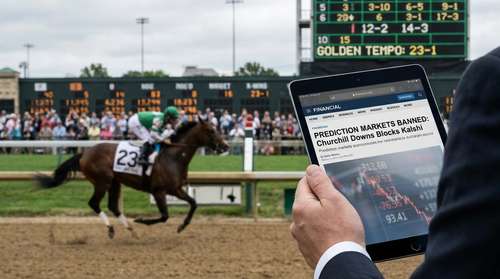
While parimutuel bettors cashed their tickets on track and through dedicated apps, a new demographic of financial traders found themselves entirely locked out. In major Churchill Downs betting news, the host track successfully executed a firm Kalshi Kentucky Derby ban, ensuring that prominent prediction markets could not profit off the premier racing event.
Prediction platforms like Kalshi and Polymarket have aggressively expanded into mainstream sports betting throughout 2025 and early 2026. They currently offer event contracts on major leagues like the NFL and NHL, effectively leveraging a framework governed by the Commodity Futures Trading Commission (CFTC). However, traditional horse racing operators rely on a vastly different and heavily fortified legal framework.
Prior to Saturday's $5 million race, Polymarket briefly listed a Derby contract before swiftly removing it at the explicit request of Churchill Downs. Kalshi, recognizing the legal jeopardy, opted not to list the race at all. With an estimated $234 million wagered on the Derby alone last year, track operators have massive financial incentives to protect their exclusive betting ecosystems.
Prediction Market Regulations and the 1978 Interstate Horseracing Act
The core of this standoff revolves around prediction market regulations and a powerful piece of federal legislation: the 1978 Interstate Horseracing Act (IHA). Unlike traditional sports—where prediction platforms have argued in court that CFTC oversight supersedes state gaming laws—the IHA is a specific federal umbrella statute. It grants track operators exclusive intellectual property rights over their racing content and parimutuel pools.
Churchill Downs CEO Bill Carstanjen addressed this directly leading up to the race. "We operate under a different legal paradigm than other sports offerings in the United States," Carstanjen explained. He emphasized that platforms require explicit, written consent from the track to take wagers in any form. Reading between the lines, he firmly warned that unauthorized contracts would be pursued aggressively via federal litigation.
Sports Gambling Legal Updates: What's Next for Bettors?
The swift preemptive action taken by Churchill Downs sets a rigid precedent for future sports gambling legal updates. The broader racing industry is already circling the wagons. National Thoroughbred Racing Association (NTRA) CEO Tom Rooney recently submitted a formal letter to the CFTC, reinforcing that unauthorized event trading on horse racing falls completely outside of prediction platforms' legal purview.
As the dust settles on the chaos of Kentucky Derby 2026 betting, the outlook for prediction markets in this space remains bleak. For bettors looking ahead to the Preakness Stakes on May 16 and the Belmont Stakes in June, the industry's message is crystal clear. If you want action on the Triple Crown, you will have to play by their rules and use traditional, licensed parimutuel operators. As prediction markets continue to disrupt the broader sports wagering industry, American horse racing has firmly and legally closed its stable doors.