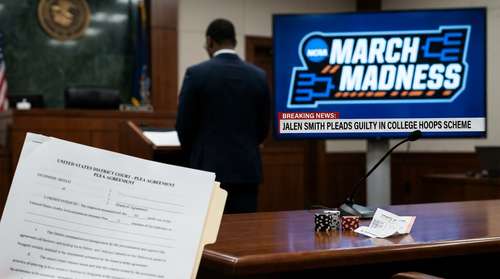
As the college hoops world gears up for the biggest tournament of the year, a devastating NCAA betting scandal 2026 has cast a massive shadow over the sport. On Monday, March 9, 2026, Jalen Smith, a key fixer in a sprawling college basketball point-shaving scheme, officially pleaded guilty in a Philadelphia federal court. This historic sports betting fraud investigation has exposed an intricate network that compromised more than 39 athletes across at least 17 different Division I programs, allowing a sophisticated criminal group to defraud legal sportsbooks out of millions of dollars.
Inside the Massive College Basketball Point-Shaving Scheme
The sheer magnitude of this NCAA betting scandal 2026 is staggering to industry experts and fans alike. What initially began as an underground operation to manipulate matches in the Chinese Basketball Association back in 2023 quickly pivoted to American collegiate courts. According to unsealed federal indictments, the fixers focused their illicit efforts on the 2023-24 and 2024-25 NCAA men's basketball seasons, ultimately rigging or attempting to rig over 29 games before authorities dismantled the network.
Criminal organizers aggressively targeted athletes at lower-profile schools, calculating that players with limited Name, Image, and Likeness (NIL) earnings would be highly susceptible to fast cash. In exchange for intentionally underperforming and failing to cover the spread, players accepted bribes ranging from $10,000 to $30,000 per game. The betting ring would then wager heavily against these compromised teams, with some individual game bets exceeding $400,000.
The Jalen Smith Guilty Plea Philadelphia: A Turning Point
The Jalen Smith guilty plea Philadelphia proceedings mark a critical turning point in the Department of Justice's sweeping crackdown. Smith, a 30-year-old basketball trainer and developer based in Charlotte, North Carolina (who is completely unrelated to the NBA player of the same name), utilized his grassroots scouting connections to recruit vulnerable student-athletes into the fold.
Appearing before a federal judge, Smith pleaded guilty to wire fraud, bribery, and illegal possession of a firearm—the latter charge stemming from an FBI raid on his bedroom last May where agents found a loaded handgun. Out of the 26 defendants formally charged in this NCAA gambling bribery charges case, he is the very first to admit guilt. Prosecutors outlined how Smith operated as the critical boots on the ground for the enterprise. In one notable instance, he traveled to Louisiana to personally deliver $32,000 in cash to two compromised players. In another, he journeyed to Chicago to hand-deliver a $40,000 bribe to four DePaul University athletes following a successfully rigged game against Georgetown.
Brazen Text Messages Expose the Operation
The federal indictment features a trove of text messages illustrating the brazen nature of the operation. In one exchange following a successful $256,000 wager against Robert Morris University, a compromised player texted Smith, "We might as well do the next one too... Too easy". When betting over $450,000 against North Carolina A&T, Smith instructed a recruited player that if the game started looking shaky, he should tell two or three other teammates, reminding them that they could easily get paid too.
March Madness 2026 Betting Integrity Under Fire
Smith's admission of guilt arrives just one week before the highly anticipated NCAA tournament tips off, placing March Madness 2026 betting integrity under intense, unprecedented scrutiny. With billions of dollars expected to be wagered both legally and illegally over the next month, regulatory bodies and sportsbook operators are on extremely high alert for any suspicious line movements or irregular betting patterns.
Since the U.S. Supreme Court struck down the federal ban on sports betting in 2018, legal gambling has experienced a meteoric rise across the nation. However, this latest Division I basketball betting news serves as a grim realization of the severe vulnerabilities inherent in the modern system. The sportsbooks themselves are considered direct victims in the federal complaint, having paid out massive, unearned sums on wagers they never would have accepted had they known the game outcomes were criminally predetermined.
What's Next in the Sports Betting Fraud Investigation?
As the dust begins to settle on Smith's landmark plea deal, the spotlight now shifts to the remaining 25 defendants. This group includes 20 current or former college basketball players alongside five other fixers who allegedly masterminded the financial side of the college basketball point-shaving scheme. While actual sentencing will depend heavily on federal guidelines and judicial discretion, the wire fraud charges carry statutory maximums of up to 20 years in federal prison, while the bribery counts carry up to five years.
For the collegiate sports establishment, this NCAA betting scandal 2026 represents a worst-case scenario come to life. It unequivocally proves that the widespread legalization of sports betting, combined with the extreme financial disparities of the NIL era, has created fertile ground for severe corruption. As the legal process continues to unfold in federal court, athletic departments nationwide will be forced to drastically overhaul their compliance protocols to ensure the fundamental integrity of the game survives this remarkably dark chapter.