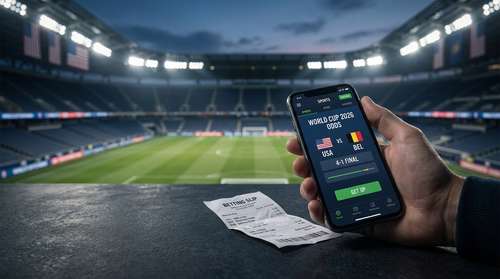

The lines between financial derivatives and sports gambling have effectively evaporated. In the biggest regulatory showdown in recent sports betting news 2026 has to offer, a formidable coalition of casino operators, tribal gaming authorities, and powerful labor unions has issued an ultimatum to the United States Senate. Coordinated by the American Gaming Association (AGA), the group sent a decisive letter on June 16, demanding a federal block to stop prediction markets from offering sports wagers. The stakes are remarkably high: as the 2026 FIFA World Cup commands global attention, platforms like Kalshi and Polymarket are absorbing billions in action, entirely bypassing state-level gambling taxes and traditional regulatory frameworks.
The Billion-Dollar Ultimatum: AGA's Push for the CLARITY Act
The traditional gaming industry is not holding back. In a coordinated, multi-organizational effort this week, the American Gaming Association, alongside the Indian Gaming Association and the UNITE HERE hospitality union, pushed the Senate to amend the pending Digital Asset Market Clarity Act. Their goal is straightforward: enact a strict AGA prediction markets ban that explicitly prevents event-contract exchanges from listing sports and casino-style outcomes.
According to the coalition's letter, the past 18 months have seen the largest unchecked expansion of gambling in American history. By rebranding traditional point spreads and moneylines as federally regulated financial products, prediction markets operate without state licenses, consumer protection guardrails, or voter approval. Traditional sportsbooks, which spend millions annually on compliance, responsible gambling initiatives, and local licensing, view this as a catastrophic loophole that threatens the legal gaming sector and undermines local control.
The Consumer Protection Argument
Beyond economics, the coalition heavily emphasizes the risk to consumers. The gaming groups argue that prediction platforms improperly market gambling products as financial investments. Because they exist in a regulatory gray area, these exchanges allegedly lack the rigorous responsible gaming safeguards mandatory for legal sportsbooks, creating an environment where users can place high-risk wagers under the guise of trading derivatives.
The Tax Drain of Kalshi Sports Wagers
At the center of this legislative hurricane is a massive financial drain on state budgets. Traditional sports betting contributes heavily to local infrastructure, public education, and municipal services through stringent tax regimes. The AGA estimates that state gaming authorities have bled approximately $1.08 billion in tax revenue since platforms began treating sports bets as financial contracts in early 2025.
Unlike regulated operators such as DraftKings or FanDuel, Kalshi sports wagers operate as peer-to-peer event contracts. Users buy "yes" or "no" shares on specific outcomes, functioning more like a stock exchange for events. Because Kalshi secured early approvals from the Commodity Futures Trading Commission (CFTC), the company leverages its federal authorization as a shield against state-level gambling enforcement. This clash of jurisdictions has turned US sports gambling regulation upside down, pitting federal derivatives law directly against decades-old local state statutes.
World Cup 2026 Betting Trends Fuel the Fire
The regulatory battle has reached a boiling point largely because of current market dynamics. The 2026 FIFA World Cup, hosted across North America, is currently driving unprecedented customer acquisition for unregulated, crypto-friendly exchanges. Eager bettors, drawn by the lack of betting limits and the appeal of peer-to-peer odds, are flocking away from traditional sportsbooks.
Current World Cup 2026 betting trends highlight a massive migration toward event contracts. The financial numbers are staggering. In May 2026 alone, Kalshi reported an astronomical trading volume of $16.8 billion, a significant leap from the previous month. Polymarket sports betting activity followed closely, capturing $7.08 billion in volume. Because Polymarket operates largely on cryptocurrency infrastructure, it attracts a younger, digitally native demographic. For the traditional casino coalition, these multi-billion-dollar figures represent lost state revenue happening in real-time during the globe's biggest sporting event.
Prediction Markets vs Sportsbooks: A Turf War Escalates
The defining question for lawmakers is who ultimately has the authority to regulate these platforms. The ongoing debate of prediction markets vs sportsbooks extends far beyond user experience, odds pricing, and tax structures; it is a fundamental dispute over legal jurisdiction.
CFTC Chairman Michael Selig has firmly defended the federal agency's oversight, arguing that prediction markets are derivative exchanges subject to exclusive CFTC jurisdiction. The agency has aggressively protected this stance, going as far as suing individual states like Minnesota and Wisconsin that attempt to enforce local gambling laws against event contract platforms. In contrast, the AGA and tribal nations argue that the CFTC fundamentally lacks the operational framework, historical expertise, and congressional mandate to oversee a nationwide sports betting apparatus.
As the Senate Banking Committee advances the Clarity Act toward a full floor vote, the outcome remains highly uncertain. If the gaming coalition successfully secures their amendment, prediction markets could be forced to immediately halt their sports offerings, resetting the landscape of American betting overnight. Should the lobbying effort fail, the federal financial loophole will remain open, forcing heavily taxed sportsbooks to compete against billion-dollar derivatives exchanges playing by a completely different set of rules.