
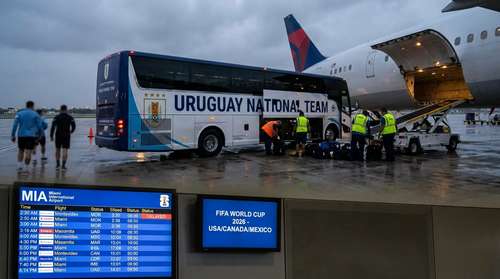
The highly anticipated start to Marcelo Bielsa's North American campaign took an unexpected turn this weekend, resulting in a frustrating Uruguay World Cup flight delay. Following a successful training camp, the South American powerhouse found themselves temporarily stranded in Mexico due to administrative paperwork errors involving their charter aircraft. The severe logistical breakdown forced the squad to scramble for alternative transportation, eventually landing in South Florida less than 24 hours before their pivotal Group H opener.
A Bureaucratic Nightmare in Mexico
The squad had been based in Playa del Carmen, finalizing preparations for their Monday night clash. However, when the traveling delegation arrived at the Cancun airport on Sunday, they were informed that their scheduled aircraft lacked the required permits to enter the United States. This unexpected FIFA World Cup 2026 travel controversy left players and staff waiting in an airport hotel for several hours while officials worked frantically to secure a replacement plane.
Escaping the Threat of Sanctions
The stakes surrounding this delay extended beyond mere physical fatigue. Because the Uruguay national team Miami arrival was pushed back so drastically, head coach Marcelo Bielsa and team captain José María Giménez were in serious jeopardy of missing a mandatory pre-match press conference. Tournament regulations strictly enforce media availability on the eve of matches, and missing the commitment could have resulted in heavy fines or disciplinary action from the governing body. Fortunately, the second aircraft dispatched from South Florida managed to deliver the team just in time to fulfill their media obligations at Hard Rock Stadium.
The Blame Game: Uruguayan Football Association Blames FIFA
This administrative blunder quickly triggered a bitter dispute regarding World Cup 2026 team logistics. With FIFA directly responsible for overseeing travel arrangements for the expanded 48-team tournament, the Uruguayan delegation did not hide their frustration. The Uruguayan Football Association blames FIFA squarely for the massive disruption.
In a pointed public statement released while the players were still grounded, the AUF noted: "Due to problems beyond the control of the AUF, the departure from Mexico has been delayed. The squad is resting at the hotel. The new departure time set by FIFA is 4.15 pm". When reporters later asked an AUF spokesperson if the global governing body was ultimately at fault for the massive disruption, the official offered a direct affirmative.
To further emphasize their displeasure, AUF officials took to their official X account and posted a classic message originally sent by Uruguayan football legend Diego Forlán back in 2010, where the former striker heavily criticized a charter flight delay ahead of a crucial match. The repost served as a highly visible jab at the tournament organizers.
FIFA Issues an Official Rebuttal
Unwilling to absorb the public relations damage without a response, FIFA issued an official statement clarifying the situation and effectively shifting the responsibility to the commercial aviation partner. "Due to an airline permitting error in Mexico, the Uruguay national team's departure from Cancun to Miami was delayed," the governing body explained. "The airline has apologized for the inconvenience caused. FIFA remained in close contact with the Uruguay national team throughout their delay and worked alongside airport and operational partners to help expedite the process and minimize disruption to the team's travel arrangements".
The Challenge of Managing World Cup 2026 Team Logistics
The 2026 tournament format presents an unprecedented logistical hurdle. With 48 teams competing across three sprawling North American nations, the margins for travel errors are practically non-existent. Aircraft authorizations, cross-border customs clearances, and varying regional aviation regulations create a complex web of requirements. This incident underscores the massive operational undertaking FIFA faces over the coming month. If a seasoned federation like the AUF can find itself temporarily barred from entering a host nation due to aircraft documentation, other competing nations will likely be scrutinizing their transit itineraries carefully.
Bielsa and Giménez Downplay the Disruption
Despite the high-stress environment typically associated with major international tournaments, the team's leadership projected an aura of absolute calm upon finally arriving in Miami Gardens. Marcelo Bielsa, known for his intense tactical focus and stoic demeanor, quickly shut down any narratives suggesting the delay would negatively impact their performance. "The flight caused no problem," the veteran manager stated flatly to the assembled press.
Captain José María Giménez offered a slightly more nuanced perspective but echoed his manager's refusal to use the situation as an excuse. Speaking through an interpreter, the Atlético Madrid defender acknowledged the underlying frustration. "We had some complications. It was a difficulty, but we actually took advantage of it because we were able to rest at the hotel," Giménez remarked.
Shifting Focus to Uruguay vs Saudi Arabia 2026
With the travel chaos now behind them, the immediate challenge lies on the pitch. The Uruguay vs Saudi Arabia 2026 fixture represents a critical starting point in a highly competitive Group H. While Uruguay arrives boasting a superior roster on paper, opening matches at the World Cup are notoriously unpredictable, and Saudi Arabia possesses the pace and tactical discipline to punish any sluggishness stemming from the shortened recovery window.
The late arrival inherently shrinks the available time for final tactical walkthroughs and acclimatization to the South Florida humidity. Pre-match routines are meticulously planned by elite technical staffs, and losing nearly a full day of localized preparation is far from ideal. How Bielsa's squad responds in the opening ten minutes at Hard Rock Stadium on Monday night will reveal whether the frustrating travel ordeal truly passed without consequence, or if the administrative failure left a lingering mark on their tournament debut.