
The global sports wagering landscape is experiencing a seismic shift as the biggest tournament in international soccer takes over North America. Kicking off on June 11 in Mexico City, the expanded tournament has already drawn historic action from fans and sharp bettors alike. Analysts project that 2026 World Cup betting will officially become the largest gambling event in human history. Fueled by a major expansion of legalized markets and a significantly longer competition schedule, sportsbooks are preparing for a massive influx of volume that will completely redefine the financial ecosystem of international sports.
Breaking Down the Macquarie Sports Betting Report
Wall Street is paying close attention to the sheer volume of capital flowing through betting platforms this summer. According to a newly released Macquarie sports betting report spearheaded by analyst Chad Beynon, total global wagering on the tournament could easily surpass the $50 billion mark. To put these projected World Cup $50 billion wagers into perspective, the 2022 edition in Qatar generated approximately $35 billion.
Reaching this new financial threshold would establish a staggering sports betting record handle, averaging roughly $500 million in bets placed per individual match. Macquarie's analysis highlights the sheer scale of the global soccer audience compared to domestic American sports. While the Super Bowl reliably draws around 200 million viewers, the 2022 World Cup final attracted an estimated 1.5 billion viewers globally. That 2022 showdown between France and Argentina drove roughly $5.25 billion in betting action. If the 2026 final at MetLife Stadium in New Jersey generates proportional activity, it will completely dwarf the estimated $1.8 billion wagered on the 2026 Super Bowl, cementing soccer's undisputed crown in the international gambling arena.
Drivers Behind the Record-Breaking Projections
The 48-Team Tournament Expansion
The primary catalyst for the betting surge is the sheer size of the 2026 competition. This marks the first time FIFA has welcomed 48 teams to the global stage, up from the traditional 32-nation format. Consequently, the schedule has ballooned from 64 matches to a sprawling 104 games spread across host cities in the United States, Canada, and Mexico. For operators offering FIFA World Cup sportsbook odds, 40 additional matches represent a massive inventory of live-betting opportunities, player props, and same-game parlays designed to keep fans engaged throughout the six-week spectacle.
The Explosion of Legal Soccer Betting USA
The domestic American market is acting as a massive multiplier for global figures. The landscape for the legal soccer betting USA market has matured rapidly since the last tournament cycle. During the 2022 World Cup, only about 40% of the American population had access to regulated sportsbooks. Today, that figure sits at a robust 65%, bringing tens of millions of potential first-time soccer bettors into the fold.
Analysts at Deutsche Bank estimate the United States alone will contribute roughly $3.3 billion to the overall global handle. Industry giants with significant market penetration are already reaping the benefits. FanDuel, backed by parent company Flutter Entertainment, is projected to capture around $1.3 billion of the domestic handle, with DraftKings trailing closely at an estimated $1.1 billion.
How to Bet on World Cup 2026: Emerging Market Trends
With an overwhelming volume of matches on the slate, casual fans are actively researching how to bet on World Cup 2026 effectively. The current landscape extends far beyond traditional moneyline wagers. Modern sportsbooks are heavily promoting micro-betting—allowing users to wager on next-minute events such as corner kicks, yellow cards, or throw-ins. Same-game parlays, which package multiple outcomes from a single match into one high-yielding ticket, have also become a dominant force for customer acquisition.
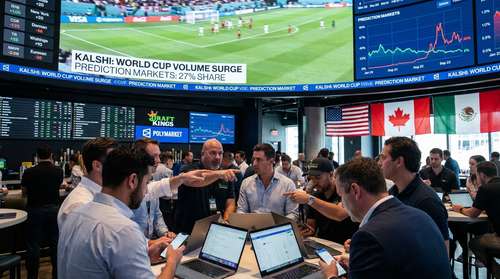
Beyond traditional sportsbooks, the 2026 tournament is serving as a breakout moment for regulated prediction markets. Platforms like Kalshi and Polymarket are capturing a unique demographic of financial traders looking to capitalize on binary event outcomes. Kalshi alone rolled out nearly 500 World Cup-specific contracts leading up to the opening match, proving that the appetite for alternative wagering vehicles is higher than ever.
Long-Term Economic Impact and Responsible Gaming
For betting operators, this historic handle isn't just about immediate revenue; it serves as a critical customer acquisition strategy. By leveraging the favorable North American time zones, sportsbooks are capturing primetime audiences across Latin America and Europe, while simultaneously building a database of domestic users who can be cross-sold on other sports later in the year.
The technology infrastructure underpinning this tournament is also completely unprecedented. Data providers like Sportradar are working closely with major betting companies to process the massive volume of real-time wagers. These companies are actively deploying artificial intelligence and machine learning to flag suspicious betting patterns that might indicate match-fixing, ensuring the integrity of the matches. At the same time, industry watchdogs are heavily emphasizing the necessity of responsible gaming frameworks. With unparalleled access to betting markets directly on smartphones, regulators are pushing operators to utilize these same advanced tracking tools to identify and intervene in problematic gambling behaviors early. Striking the right balance between capitalizing on this historic economic boom and protecting vulnerable consumers will be the ultimate test for the sports betting sector over the next six weeks.