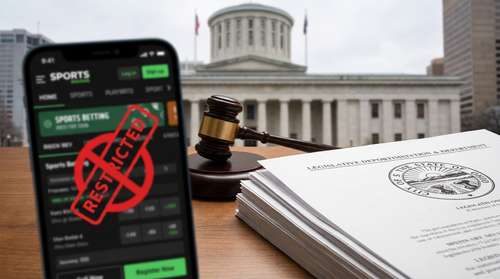
In what could become the most dramatic legislative reversal in modern gaming history, lawmakers have formally introduced a sweeping proposal aimed at a complete Ohio sports betting ban for mobile devices. Filed as Ohio House Bill 971, the legislation—dubbed the Save Ohio Sports Act—seeks to effectively erase the state's thriving digital wagering market. If enacted, the bill would eliminate mobile applications entirely, force all gambling to take place inside brick-and-mortar casinos, and strictly cap wagering frequency. Coming just years after the market's highly anticipated 2023 launch, the proposed overhaul has sent shockwaves through the industry, threatening a legal betting ecosystem that generated nearly $90 million in tax revenue in the first five months of 2026 alone.
The End of Online Wagering? Inside the Save Ohio Sports Act
Introduced formally on July 1 by Republican State Representatives Johnathan Newman and Beth Lear, the Save Ohio Sports Act represents an unprecedented attempt to roll back digital gaming expansion. The primary mechanism of the bill eliminates all statewide digital access, confining legal sports betting exclusively to in-person wagers at licensed retail casino properties.
Representative Newman did not mince words when presenting the bill at the Statehouse, arguing that the social and economic costs of highly accessible smartphone gambling far outweigh the tax benefits. Pointing out that an estimated 95% of local bettors make deposits without ever processing a withdrawal, Newman pushed back against the industry's economic narrative. "Monetizing addiction to fund public education is the wrong direction for Ohio," Newman stated during the bill's introduction, adding that only massive gambling corporations truly win.
This political shift has been brewing for months. Earlier this year, Ohio Governor Mike DeWine publicly expressed regret over the scale of sportsbook advertising and the severe social consequences of mobile betting access, citing rising addiction rates. The introduction of this legislation takes those concerns to their absolute legislative extreme.
Decoding Ohio House Bill 971: What Bettors Stand to Lose
For consumers, the legislation represents a drastic reduction in betting freedom. Beyond simply cutting off internet access, Ohio House Bill 971 targets the very mechanics of how Americans wager today, aiming to eliminate the most popular products offered by modern bookmakers.
Strict Ohio Sports Betting Limits and Market Bans
The proposed Ohio sports betting limits are aggressively tight and completely reshape the wagering experience. Under the new framework, individual wagers would be capped at a maximum of $100. Furthermore, bettors would be restricted to placing no more than eight total bets within any given 24-hour window. To prevent players from wagering with borrowed funds, the legislation also entirely outlaws credit card deposits.
But the restrictions on available betting markets are even more severe. The legislation calls for a complete prohibition of in-game live betting, player prop wagers, and multi-leg parlay bets. Additionally, betting on all collegiate sporting events would be strictly forbidden. With parlays and in-play betting eliminated, sportsbooks would be limited solely to offering traditional pre-game, single-game wagers.
DraftKings, FanDuel Ohio Restrictions: A Devastating Blow to Operators
Since the regulated market went live, digital platforms have completely dominated the landscape, accounting for nearly all wagering activity in the state. A total mobile blackout would enact crippling DraftKings FanDuel Ohio restrictions, effectively freezing out the corporate titans that have invested hundreds of millions in user acquisition, partnerships, and localized advertising across the Buckeye State.
These Ohio online sportsbooks are looking at the potential collapse of a massive market. Stripping away mobile accessibility and high-margin products like parlays—which are the primary profit engines for operators—would eviscerate commercial viability. If the bill passes, operators would likely be forced to geofence their vastly reduced retail offerings to physical locations, completely dismantling the current digital business model and severely cutting into the tax dollars earmarked for public education and problem gambling funds.
The Road Ahead for US Sports Betting Regulations 2026
While the proposed legislation still faces a long and contentious journey through the statehouse, its formal introduction signals a growing political backlash against the rapid proliferation of mobile gambling. As analysts examine the broader landscape of US sports betting regulations 2026, Ohio has unexpectedly emerged as a critical battleground that could set a new precedent for other states grappling with gambling expansion.
Proponents of the bill insist that aggressive action is required to protect vulnerable citizens and the integrity of athletics from the unchecked growth of sports gambling. Conversely, industry advocates and market critics warn that passing such a draconian law will inevitably backfire. By dismantling the legal, regulated market, critics argue that Ohio will simply drive consumers directly into the waiting arms of unregulated, offshore operators who offer zero consumer protections, all while blowing a massive hole in the state's budget.
As the debate over House Bill 971 heats up in Columbus, the entire sports gaming industry will be watching closely. Whether this becomes a localized legislative hurdle or the beginning of a nationwide rollback remains to be seen, but the days of unchecked sportsbook expansion in Ohio appear to be severely challenged.