
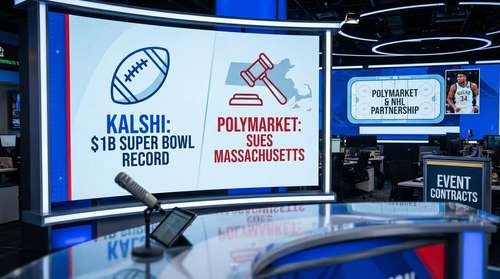
The landscape of sports wagering is undergoing a seismic shift following a record-breaking Super Bowl weekend that saw prediction market platform Kalshi process over $1 billion in trading volume. This 2,700% year-over-year surge has emboldened the industry to aggressively challenge state regulations, with competitor Polymarket filing a landmark federal lawsuit against Massachusetts on Sunday. As major leagues like the NHL and MLS embrace these platforms and NBA superstar Giannis Antetokounmpo joins as a key investor, the battle between federal sports prediction markets and state gambling regulators has reached a fever pitch.
Kalshi Super Bowl Record Shatters Expectations
The numbers from Super Bowl LX are nothing short of revolutionary for the prediction market sector. Kalshi reported a staggering $1 billion in total event contract volume tied to the big game, a massive leap from the previous year. While approximately $500 million of this activity focused on the game winner, a significant portion—over $113 million—flowed into non-traditional markets, such as the opening song of Bad Bunny's halftime show.
This data reveals a crucial trend: users are treating these platforms differently than traditional sportsbooks. The explosive growth of these "side markets" demonstrates that event contracts gambling is evolving beyond simple win-loss outcomes into a broader financial asset class. "We are seeing a new type of engagement where fans want to trade on culture as much as they do on the final score," a Kalshi spokesperson noted following the event.
Regulatory Firestorm: Kalshi Tennessee Injunction & Polymarket's Counterattack
The industry's commercial success has triggered an immediate and intense legal battle over sports betting regulation 2026. On Friday, February 20, Kalshi secured a critical legal victory when a federal judge in Tennessee granted a preliminary injunction blocking the state from enforcing its gambling laws against the platform. Judge Aleta Trauger ruled that Kalshi's products are likely "swaps" regulated exclusively by the federal Commodity Futures Trading Commission (CFTC), not state gaming commissions.
Emboldened by the Kalshi Tennessee injunction, rival platform Polymarket escalated the conflict on Sunday, February 22, by filing a federal lawsuit against Massachusetts. The suit seeks to preempt state enforcement actions, arguing that the CFTC has exclusive jurisdiction over its markets. This aggressive move sets the stage for a likely Supreme Court showdown, as federal courts in Nevada and Maryland have recently issued conflicting rulings favoring state regulators.
Major Leagues and Stars Pick Sides
While regulators clash in the courtroom, professional sports leagues are voting with their feet. The Polymarket NHL partnership, established in late 2025, has paved the way for broader acceptance. This momentum continued in January 2026 when Major League Soccer (MLS) named Polymarket its official prediction market partner, a first for the soccer world.
Individual athletes are also capitalizing on the trend. In early February, NBA two-time MVP Giannis Antetokounmpo Kalshi investment news broke, with the "Greek Freak" joining the company as a shareholder. "I look for winners, and it's clear to me prediction markets are the future," Antetokounmpo stated. His involvement lends massive credibility to the sector, further blurring the lines between traditional sports fandom and financial speculation.
The Future of Event Contracts
The core of the dispute lies in the definition of these financial instruments. State regulators argue that betting on sports outcomes is gambling, regardless of the mechanism. However, platforms like Kalshi and Polymarket contend that their "event contracts" are hedging tools similar to corn or oil futures, designed to manage risk rather than purely wager. With the Trump administration's CFTC chair recently signaling support for federal jurisdiction in an amicus brief, the federal government appears poised to defend these markets against state bans.
As the legal dust settles, the financial reality is undeniable. With billions in volume and institutional backing from figures like Antetokounmpo, prediction markets have successfully carved out a lucrative niche that traditional sportsbooks cannot easily replicate. Whether they will replace traditional betting or exist alongside it depends on the looming court battles that will define the rules of the game for 2026 and beyond.